In this article
Typeform solves the wrong problem for you. It is built for marketing teams running branded, high-volume form programs, not a solopreneur who needs fifteen honest answers before deciding whether to build something.
A validation survey has one job: send 5 to 10 questions to 20 to 50 people who match your target customer, then read the pattern in the answers. That is a one-time, low-volume task. Typeform’s pricing, however, is built around response volume and seats, because its actual customer is a growth team running dozens of forms a month.
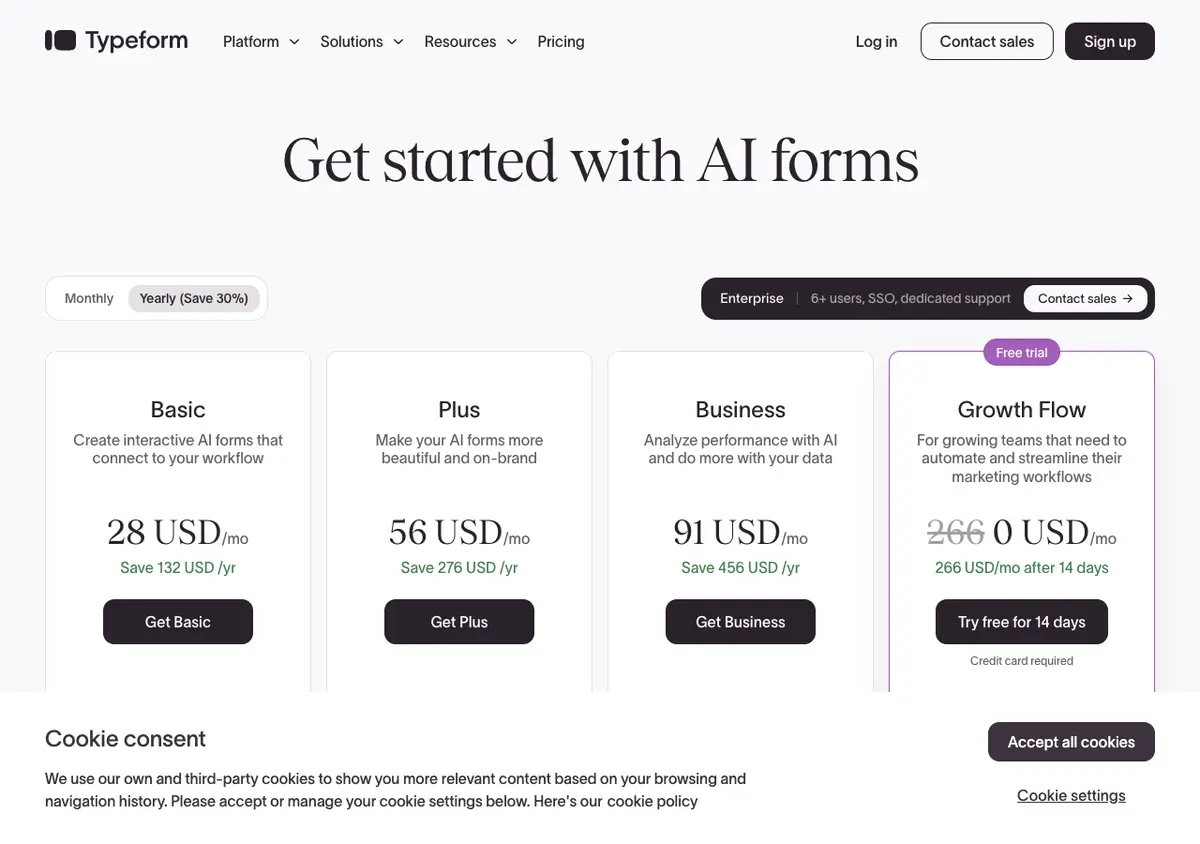
Typeform’s Basic plan starts at $28 a month for 100 responses and one user, according to Typeform’s pricing page (fetched September 2026). Typeform also references a separate free plan on the same page (“Try our Free plan then upgrade when you’re ready”), though the response cap on that tier is not listed on the public pricing table. Either way, you are paying for infrastructure meant for a recurring form program, not a single validation test you run once and then close.
This guide compares four Typeform alternatives solopreneurs actually reach for when the job is idea validation, not brand-consistent lead forms: Google Forms, Tally, Jotform and Formbricks. If you have not scored the idea itself yet, run it through the idea validation scorecard first. The survey tool matters less than whether you already know the ten questions worth asking.
Google Forms: The Zero-Cost Default
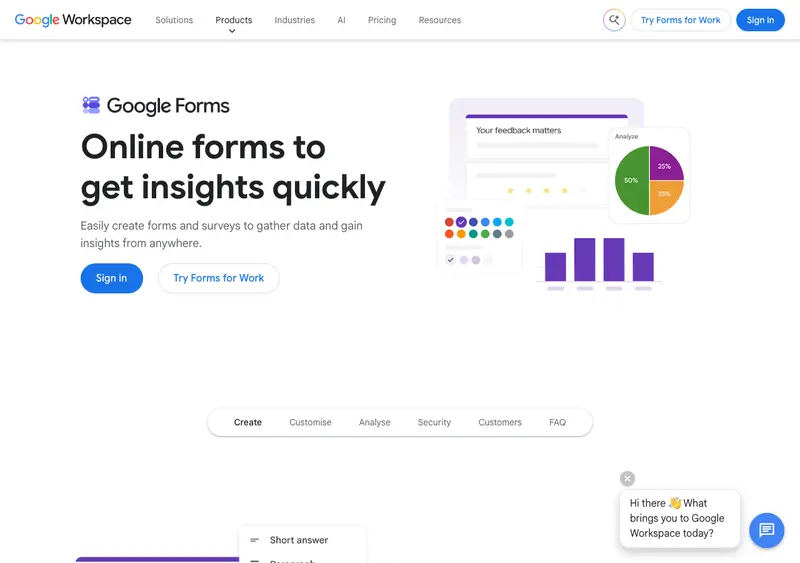
Google Forms is the tool most solopreneurs already have open in another tab. It is free with any Google account, has no published response cap tied to a pricing tier, and every response lands directly in a Google Sheet you can filter without exporting anything.
The tradeoff is presentation. Forms looks like a form, not a designed experience. For a validation survey, that is rarely a cost. You are not trying to impress the respondent with your brand. You are trying to get an honest answer from someone who has ninety seconds to give it to you, and a plain form with a clear question often earns a more honest answer than a polished one, because nobody feels like they are being sold something.
Where Forms falls short next to Typeform: branching logic is basic, and there is no native way to collect a payment inside the form. If your validation test includes a pre-sale question (“would you pay $29 for this, reserve your spot here”), you will need to pair Forms with a separate payment link. For question wording and where to find respondents, see our guide to using Google Forms to validate a product idea.
Who this is for: Anyone running their first validation survey who wants zero cost, zero setup time, and does not need payment collection built into the form itself.
Tally: No Response Cap, and Typeform’s One-Question Feel for Free
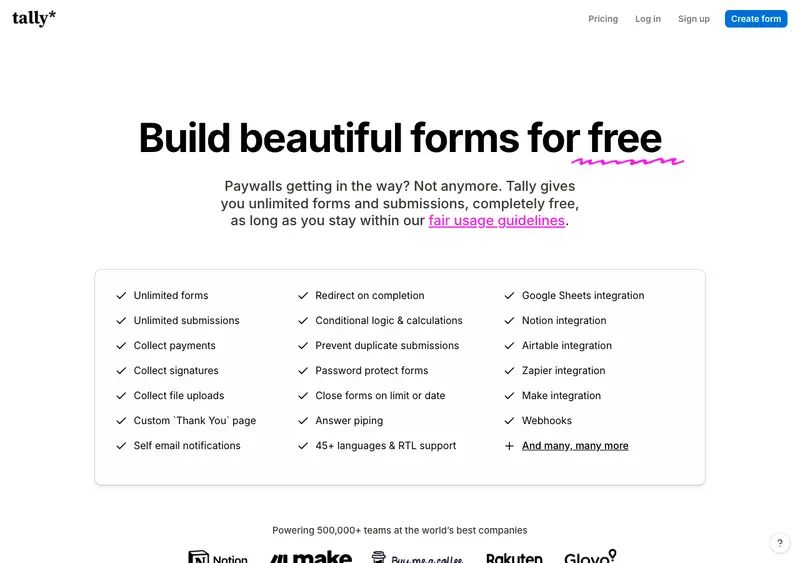
Tally’s whole pitch is unlimited forms and submissions within a stated fair-use policy, at no cost, according to Tally’s pricing page (fetched September 2026). It also supports the one-block-at-a-time layout that made Typeform popular, without a response ceiling attached to that format.
For a validation survey where you genuinely do not know if you will get 15 responses or 150, that removes a variable you would otherwise have to track. The free plan includes conditional logic, file uploads, payment collection, e-signatures, and integrations with Google Sheets, Airtable and Zapier. The tradeoff is Tally branding on the form and no custom domain, unless you upgrade to the Pro plan at $24 a month, per the same pricing page.
For a solo founder running a single validation survey, the free plan covers the entire workflow, including the payment field if your test includes a “would you actually pay” pre-sale question.
Who this is for: Anyone who wants Typeform’s conversational, one-question-at-a-time feel without a response cap or a monthly bill.
Jotform: When the Survey Needs to Collect a Payment or a Signature
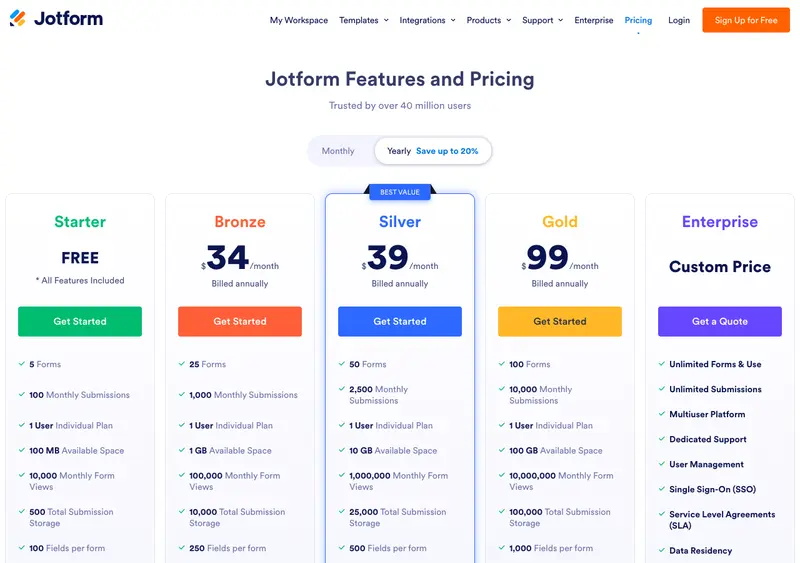
Jotform’s free Starter plan includes the core form builder and payment integrations, but keeps Jotform branding on the form and caps your monthly submissions at 100, according to Jotform’s pricing page (fetched September 2026). Paid tiers, named Bronze ($34/mo), Silver ($39/mo) and Gold ($99/mo) on annual billing per the same page, raise those limits and remove the branding as you move up.
What makes Jotform worth a look for validation specifically: payment integrations, e-signature collection and conditional logic all ship on the free tier, in the same form. If your test is not just “does this problem resonate” but “will you put a card down to reserve early access,” Jotform lets you ask the demand question and collect the pre-sale signal in a single form, without stitching together a survey tool and a separate payment link.
The cost of that flexibility is a denser editor than Google Forms or Tally. If you have never built a form before, budget slightly more setup time than the other three tools here.
Who this is for: Solopreneurs running a pre-sale-style validation test where the survey needs to end in a real payment or a signed commitment, not just an opinion.
Formbricks: For the Founder Who Wants the Data, Not the Vendor
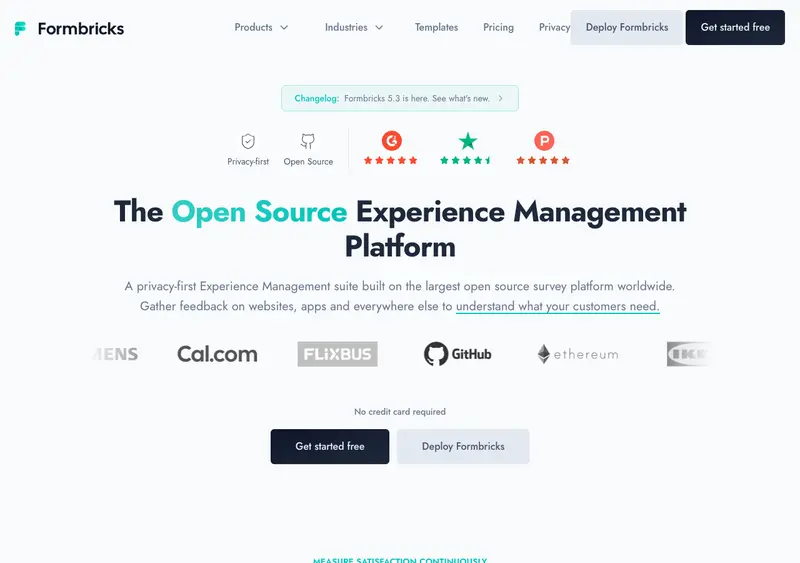
Formbricks is an open-source survey and experience-management platform you can self-host for free, or run on its hosted plan, positioned as a privacy-first alternative to closed survey tools, per Formbricks’ own site (fetched September 2026). For Kai’s kind of reader, the indie SaaS founder who already runs a small stack of self-hosted tools, this is the option that keeps a validation survey’s raw response data under their own control instead of a vendor’s database.
The setup cost is real. Self-hosting means you are running infrastructure, even lightweight infrastructure, instead of clicking “sign up.” That is a fair trade for a technical founder who is validating a developer-facing or privacy-sensitive idea, where “we do not store your answers on someone else’s server” is itself part of the pitch to respondents. It is a poor trade for Nina or Marcus, who want a link they can share in the next ten minutes.
Who this is for: Technical founders validating a developer tool, privacy-focused product, or any idea where data ownership is part of the credibility story you are testing.
Tool Comparison at a Glance
| Tool | Starting price | Free tier limit | Payment collection (free) |
|---|---|---|---|
| Typeform | $28/mo (Basic) | Free plan referenced, cap not published | No |
| Google Forms | Free | No published response cap | No |
| Tally | Free | Unlimited forms & submissions (fair use) | Yes |
| Jotform | Free (Starter) | 100 submissions/mo, Jotform branding | Yes |
| Formbricks | Free (self-hosted) | Unlimited, self-hosted | Yes |
Pricing and limits per each tool’s own pricing page, fetched September 2026.
Pros and Cons of Skipping Typeform for a Validation Survey
What you gain:
- A free tier that covers a full validation test. Google Forms, Tally and self-hosted Formbricks all let you run 20 to 50 responses without hitting a paywall.
- Faster setup for the job at hand. All four alternatives get you from a blank editor to a shareable link in well under an hour, with no seat negotiation or sales call.
- No enterprise features you do not need. Typeform’s Business and Growth Flow tiers add Salesforce integration, multi-language forms and priority support, per its pricing page. None of that changes whether five strangers describe the same pain point.
What you give up:
- Typeform’s specific conversational polish and its AI-assisted form creation, which the free alternatives approximate (Tally) but do not fully match.
- Brand consistency. If you are testing an idea under an existing brand with design standards, Typeform’s theming options are more mature than Tally’s or Jotform’s free tiers.
Which Tool to Use
Use Google Forms if this is your first validation survey and you want zero cost, zero learning curve, and answers landing directly in a spreadsheet you already know how to read.
Use Tally if you want Typeform’s one-question feel without a response cap or a monthly bill, and you might need payment collection later.
Use Jotform if the survey needs to end in an actual pre-sale payment or a signed commitment, not just an opinion.
Use Formbricks if you are validating a developer-facing or privacy-sensitive idea and want the response data on infrastructure you control.
A survey alone tells you whether a problem resonates. It does not tell you whether someone will pay. Pair whichever tool you choose with a handful of real conversations using our customer interview scripts before you treat the results as a green light.
Frequently Asked Questions
Is Typeform worth paying for to validate a business idea?
Rarely, for a one-time test. Typeform’s Basic plan starts at $28 a month for 100 responses, priced for a recurring form program, not a single validation survey. Free tools like Google Forms or Tally cover the same 20-to-50-response test at no cost.
What is the closest free alternative to Typeform’s one-question format?
Tally is the closest match. It offers the same one-block-at-a-time layout Typeform is known for, plus unlimited forms and submissions within a stated fair-use policy, according to Tally’s pricing page.
Can I use Google Forms instead of Typeform for a validation survey?
Yes. Google Forms is free, has no published response limit, and exports answers straight to Google Sheets for filtering. It lacks native payment collection and Typeform’s conditional-logic depth, so pair it with a separate payment link if your test includes a pre-sale question.
How many survey responses do I need to validate an idea?
Most validation surveys aim for 20 to 50 responses from people who actually match the target customer, not friends and followers. The goal is pattern recognition, not statistical proof. Three or more respondents describing the same problem in their own words is worth more than the exact response count.
Does a Typeform survey alone prove people will pay for my idea?
No. A survey measures whether a problem resonates, not purchase intent. Someone can agree a problem is real without ever paying to solve it. To test willingness to pay, add a pre-sale question with a real payment link (Tally, Jotform and Formbricks all support this on their free tiers) or follow up with direct customer conversations.
Keep Reading
What to Do Next
Choose the path that fits where you are right now.
Get the 7-Day Idea Test (Free)
Download the free 7-Day Idea Test. One task per day. Four evidence signals. One clear go, wait, or kill result — before you spend months building the wrong thing.
Send Me the PlaybookStart Reading
Read the step-by-step setup guide for your platform.