In this article
Most ideas die surrounded by praise.
People said it sounded great. A few said they would definitely use it. Then you built it, and the room went quiet. Market validation exists to catch that gap while it still costs two weeks, not six months.
What Is Market Validation and How Is It Different from Market Research?
Market validation is the process of collecting evidence that a specific group of buyers has a problem, can be reached, and will act or pay to solve it, before you build. CB Insights found poor product-market fit in 43% of 431 VC-backed startup shutdowns since 2023.
That 43% comes from venture-backed companies, so treat it as a warning, not a forecast for your side project. The pattern still holds for solo founders. You do not usually fail because the idea was impossible. You fail because nobody checked whether anyone cared enough to act.
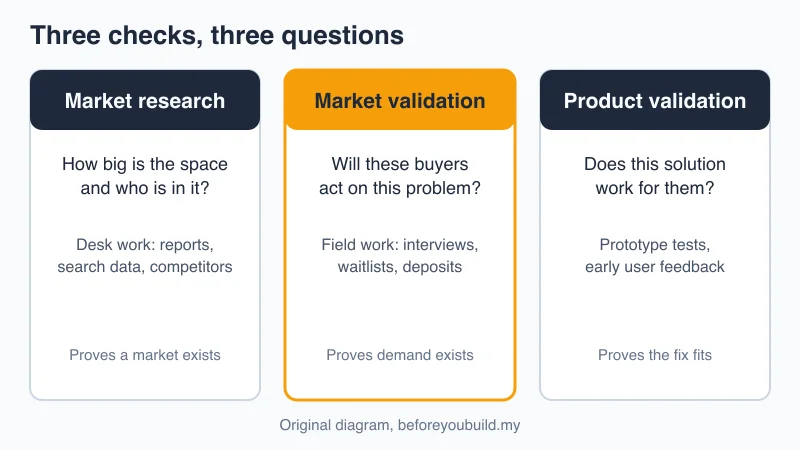
Market validation is easy to confuse with two neighbors. Market research asks how big the space is. Product validation asks whether your solution works. Market validation sits between them and asks one narrow question: will these buyers move?
| Check | Core question | Typical method | What it proves |
|---|---|---|---|
| Market research | How big is the space and who is in it? | Reports, search data, competitor pages | A market exists |
| Market validation | Will these buyers act on this problem? | Interviews, waitlists, deposits | Demand exists |
| Product validation | Does this solution work for them? | Prototypes, early user feedback | The fix fits |
Source: BeforeYouBuild framework. The comparison is our own working model, not an industry standard.
If you want the sizing side, see our guide to TAM, SAM and SOM for solo founders. If you want the product test, read how to validate a product idea. This article covers the middle step most people skip.
What Evidence Counts as Market Validation?
Evidence counts when it costs the other person something. A compliment costs nothing. A reply, a signup, a booked call or a refundable deposit costs time, attention or money. The Mom Test book by Rob Fitzpatrick makes the same point: people will say almost anything to be polite.
The Mom Test’s own tagline promises to teach you how to learn if a business is a good idea “when everyone is lying to you”. Nobody is lying out of malice. They are being kind, and kindness is useless as data.
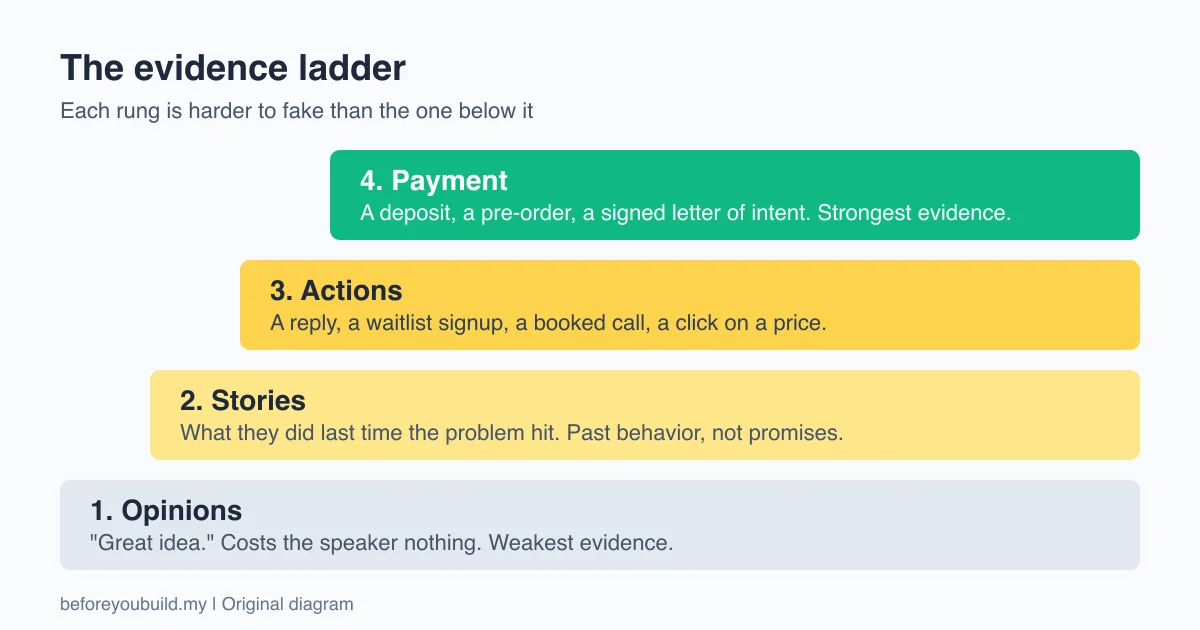
So rank every signal by what it cost the person who gave it. We call this the evidence ladder:
- Opinions. “Great idea.” “I would totally use that.” Free to give, so weak evidence.
- Stories. A specific account of what they did the last time the problem hit. Past behavior beats future promises.
- Actions. A reply to your email, a waitlist signup, a booked call, a click on a price.
- Payment. A deposit, a pre-order or a signed letter of intent. The hardest to fake.
The rungs are our own framework, built on the same logic as the Mom Test and on how early demand signals work before launch. They are not a scientific scale.
Here is the rule that makes the ladder useful. Climb at least one rung above where you are comfortable. If you have only opinions, go collect stories. If you have stories, ask for an action. If you have actions, ask for money.
How Do You Define the Market You Are Validating?
A market you can validate is a group you can name, find and message. “Small business owners” is a category. “Solo coaches in North America who sell one-to-one packages and want a group program” is a market. If you cannot list where ten of them gather, you cannot validate yet.
Vague markets hide failure. If your buyer is “anyone who wants to be productive,” every conversation confirms the idea because everyone has felt unproductive. Nothing can disprove you, so nothing proves you.
Write one sentence before you talk to anyone:
"[Specific person] who [specific situation] is struggling to [specific outcome], and currently handles it by [current workaround]."
Then run three checks on the sentence.
Can you name them? You need a job title, a situation or a trigger event. “Indie SaaS founders who just quit a salaried job” works. “Entrepreneurs” does not.
Can you reach them? Think about specific places: a subreddit like r/SaaS, a Slack group, a niche newsletter, a LinkedIn search. If the only way to reach them is paid ads to a cold audience, validation gets slower and more expensive.
Do they already spend on the problem? A current workaround is the best sign of a real market. Someone who pays for a clumsy tool, hires a freelancer, or builds a spreadsheet has already voted with effort.
Be honest about one weakness. A narrow market can look too small. That is fine at this stage. A sharp, small market you can reach beats a huge one you cannot. You can widen later, once someone has actually paid.
Does this sound like your idea right now? Score the whole idea, not just the market, with the Idea Validation Scorecard. 15 minutes. Free. No pitch.
How Do You Run a Market Validation Test in Two Weeks?
A two-week market validation test has two phases: about ten buyer conversations in week one, then one low-cost action test in week two. Buffer founder Joel Gascoigne used the second phase: a two-page site, then a pricing page, before building the product.
The ten-conversation figure is our working target, not a research result. Fewer than that and one chatty person skews everything. More than that and you are probably avoiding the next step.
Week one: stories, not pitches.
- Day 1 to 2: write your market sentence and list 30 people who fit it.
- Day 3 to 5: message them for a 15-minute chat about the problem, not your idea.
- Day 3 to 7: hold the conversations and ask about the last time the problem happened. What did they try? What did it cost? What did they do next?
Our guide to Mom Test questions has a full question bank. The short version: talk about their life, not your solution, and never ask “would you pay for this?”
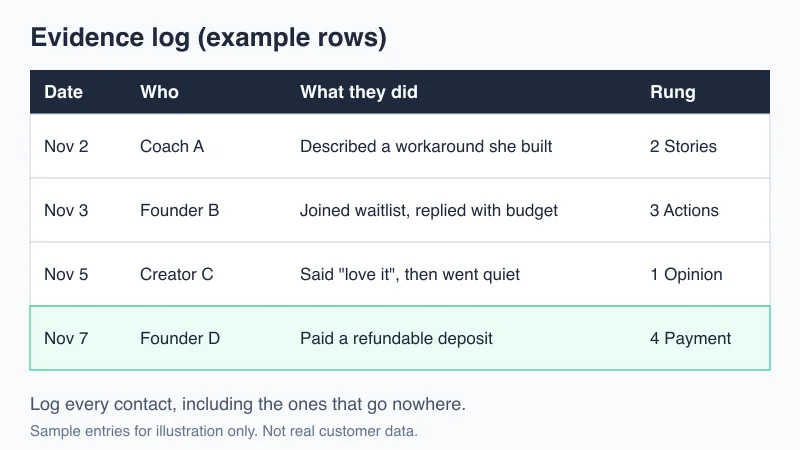
Log every contact, including the ones that go nowhere. A log turns a feeling into a record, and a record is harder to talk yourself out of. Use the rung number from the ladder so you can count later.
Week two: one action test. Pick the cheapest test that asks for a real step.
- Waitlist page. A short page that states the problem and outcome, with an email field. Send the 30 people you listed, plus one or two communities where they gather.
- Price click. Add a pricing step before the email field, as Buffer did. In Buffer’s own write-up, Gascoigne says the extra step tested both pricing and demand, because people had to take one more click. The result he reports: people kept giving their email, and a small number clicked paid plans. He then started building.
- Refundable deposit. For higher-priced ideas, ask for a small refundable deposit or a letter of intent from three to five people.
Note what Buffer did not do. It did not build the product first. It also did not claim a huge result from a small number of clicks. It took a small, honest signal and moved on to the smallest real version.
For price testing in depth, see our guide to a willingness to pay survey. For a weekend version of the action test, see how to run a demand test in one weekend.
How Many Signals Are Enough to Say Go, Wait or Kill?
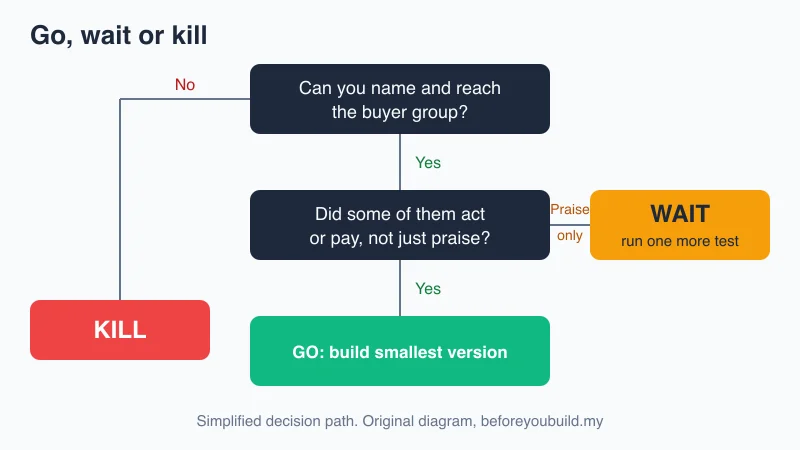
There is no universal number, so set your thresholds before you start. A reasonable working rule for a solo test: at least three of ten buyers describe the problem unprompted, and at least one in five of those reached takes a real action. Write the rule down first.
These thresholds are BeforeYouBuild’s working guideline, not a published benchmark. Their job is to stop you from moving the goalposts after you see the data.
| Result after two weeks | What it likely means | Decision |
|---|---|---|
| Buyers cannot be named or reached | No testable market yet | Kill or reframe the market |
| Many compliments, no actions | Polite interest, weak demand | Wait: change the offer or segment, retest |
| A few stories plus a few actions, no money | Real pain, price or fit unproven | Wait: run one payment test |
| Stories, actions and at least one payment | Demand with proof of intent | Go: build the smallest version |
Source: BeforeYouBuild decision framework, our own model.
Two cautions keep the rule honest.
First, count only what you did not coax. If a friend signs up because you asked them personally, that is a favor, not a market signal. Mark it as such in the log.
Second, a kill is a good result. You spent two weeks, not a quarter. Skipping evaluation is not bold. It is expensive. A clean kill returns months of your life.
If you land on wait, do not just keep talking. Change one variable, such as the segment, the promise or the price, and rerun the shorter test. For a seven-day format of this loop, use the one-week idea test.
What Mistakes Make Market Validation Fail?
Market validation fails most often when founders ask friends, pitch instead of listen, or mistake an audience for a market. Each mistake produces reassuring data that does not predict purchases. The fix is the same each time: ask for something that costs the person more than words.
Asking people who love you. Friends and family are not your target buyers, and they want you to feel good. Our article on how much validation is enough covers when to stop collecting and start deciding.
Pitching in the interview. The moment you describe your solution, people react to the solution. You learn nothing about the problem. Keep the first conversation about their last experience.
Confusing an audience with a market. Thousands of followers are attention, not demand. A YouTuber with a large channel can still sell a handful of copies of a product, because viewers came for free content. Test whether your followers will act, not just watch.
Using hypothetical questions. “Would you buy this?” invites a polite yes. “What did you do the last time this happened?” invites a fact.
Counting every positive as a signal. Sort by rung. Ten opinions are not equal to one deposit.
Validating the solution too early. If people say the problem is real but dislike your fix, the market is fine and the product needs work. Do not kill a market because your first answer was wrong. Move to product validation once the market evidence is solid.
Skipping the log. Without a written record, you will remember the two enthusiastic calls and forget the eight lukewarm ones. Memory flatters you. The log does not.
A last note on scope. This article stops at the go, wait or kill decision. How you price, package and sell what you build comes after, and that belongs to a different kind of work, such as the offer design covered at OfferEngine.
Frequently Asked Questions
What is market validation?
Market validation is collecting evidence that a defined group of buyers has a problem and will act or pay to solve it, before you build. It focuses on demand, not product quality. CB Insights found poor product-market fit in 43% of 431 analyzed startup failures since 2023.
How long does market validation take?
A focused solo test takes about two weeks: roughly ten buyer conversations in week one, then one action test such as a waitlist, price click or refundable deposit in week two. This is a working guideline from BeforeYouBuild. Slower channels or narrow markets can stretch it.
What is the difference between market validation and market research?
Market research estimates how large a space is and who competes in it, usually from reports and search data. Market validation tests whether specific buyers will take a real step, such as signing up or paying. Research shows a market exists. Validation shows demand exists inside it.
Can I validate a market without building anything?
Yes. Interviews, a waitlist page, a pricing click test and refundable deposits all need no finished product. Buffer’s founder tested demand with a two-page site and a pricing step before building, according to Buffer’s own account. The goal is evidence of action, not a working product.
How many people do I need to talk to?
There is no fixed number. About ten conversations with people who truly match your target is a sensible starting point for a solo test, though that figure is a working guideline rather than a research result. Stop when answers repeat, and keep logging each contact.
Ready to test your market, not just read about it?
Pick one idea, write your market sentence, and run the two-week test above. Then score the idea against the rest of the framework before you decide.
Run the Idea Validation Scorecard
15 minutes. Free. No pitch.
Keep Reading
What to Do Next
Choose the path that fits where you are right now.
Get the 7-Day Idea Test (Free)
Download the free 7-Day Idea Test. One task per day. Four evidence signals. One clear go, wait, or kill result — before you spend months building the wrong thing.
Send Me the PlaybookStart Reading
Read the step-by-step setup guide for your platform.