In this article
Market research does not need a budget.
It needs a plan and a stop date. Most solo founders have neither, so they read for months and learn little. This guide gives you six cheap methods, the free data behind them and a clear point to stop.
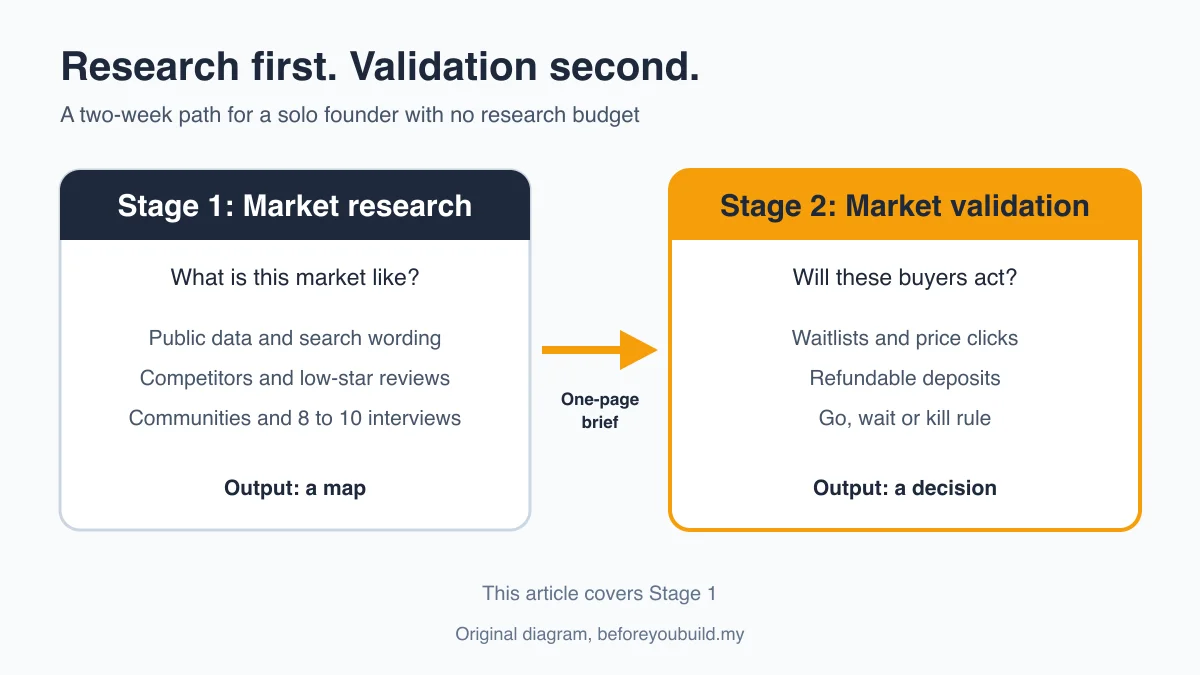
What Is Market Research for a Startup?
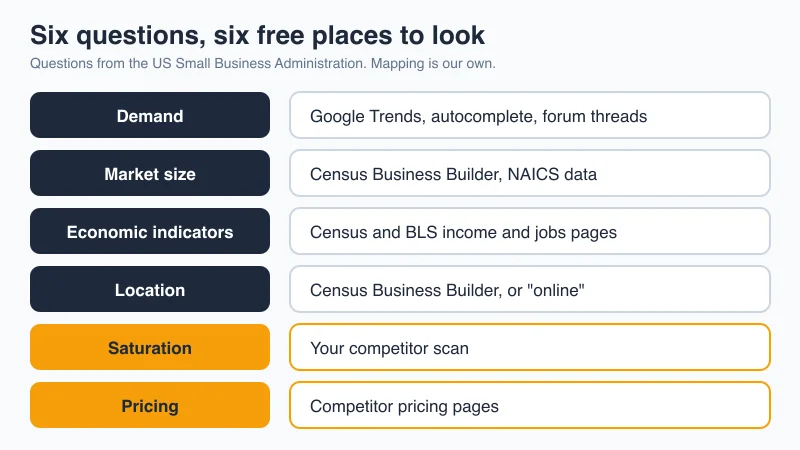
Market research for a startup is the work of learning who your customers are, what they do today, who else serves them and what they pay, before you build. The US Small Business Administration lists six questions it answers: demand, market size, economic indicators, location, saturation and pricing.
The Small Business Administration puts it plainly: market research “lets you reduce risks even while your business is still just a gleam in your eye.” For a solo founder, the risk is not abstract. It is your savings and your evenings.
The stakes are real even for well-funded teams. CB Insights studied 431 venture-backed startups that shut down since 2023 and found poor product-market fit in 43% of them. Those companies had money and staff. You have neither, so you need to find the same problem earlier and cheaper.
But there is a trap. Research feels like progress, and it is easy to confuse with proof. They are two different jobs.
| Market research | Market validation | |
|---|---|---|
| Core question | What is this market like? | Will these buyers act? |
| What you collect | Facts, language, prices, competitors | Replies, signups, deposits |
| Typical work | Desk research, reviews, interviews | Waitlists, price tests, pre-orders |
| What it gives you | A map | A decision |
| Where it fails | Never stops | Tests the wrong buyer |
Source: BeforeYouBuild working model, not an industry standard.
Research draws the map. Market validation tests whether anyone will walk to the destination. This article covers the map. If you skip it, your validation test will aim at the wrong people.
How Much Does Startup Market Research Cost a Solo Founder?
Solo-scale market research can cost close to nothing in cash and about 20 hours of time. The SBA warns that direct research “can be time consuming and expensive,” so a solo founder should favor free public data, reviews and a handful of interviews over paid panels and focus groups.
The SBA names four direct methods: surveys, questionnaires, focus groups and in-depth interviews. Focus groups and large surveys are built for companies with budgets and recruiters. You can skip them for now.
Here are six methods that fit one person. The costs and hours are BeforeYouBuild working estimates, not published benchmarks. Your pace will vary.
| Method | Cash cost | Time | Answers | Weak spot |
|---|---|---|---|---|
| Public data (Census, SBA lists) | $0 | 2 to 3 hours | Size, income, location | Too broad for a niche |
| Search data (Google Trends, autocomplete) | $0 | 1 to 2 hours | Interest and wording | Shows interest, not intent to pay |
| Competitor scan | $0 | 3 to 4 hours | Saturation, pricing | Hides what they get wrong |
| Reviews and community threads | $0 | 4 to 6 hours | Pains and buyer language | Vocal minority bias |
| Customer interviews | $0 to $50 | 6 to 10 hours | Current workarounds, spend | Politeness and small samples |
| Micro-survey (free form tool) | $0 | 2 hours plus waiting | Frequency of a problem | Weak if you reach the wrong people |
Source: BeforeYouBuild working estimates. Costs assume free tiers and your own outreach.
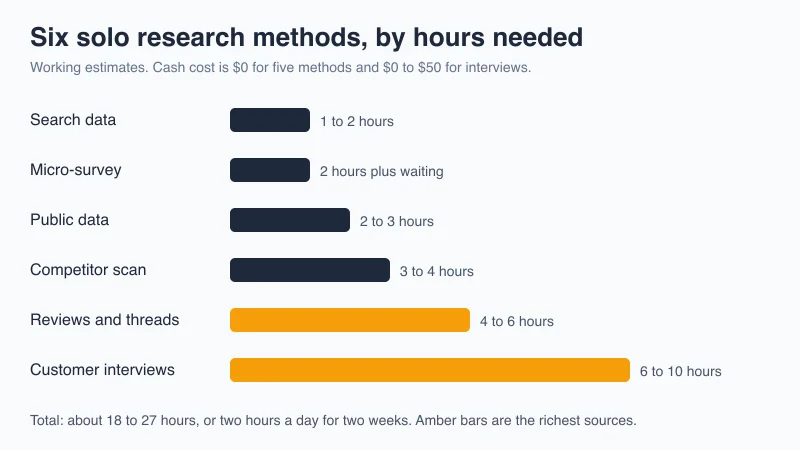
The total is roughly 18 to 27 hours. Spread across two weeks, that is about two hours a day. Set that cap now. A cap is the cheapest research tool you own, because it forces you to choose.
Be honest about one weakness. Free methods are noisier than paid ones. A paid panel gives you a cleaner sample. For a solo idea, a noisy answer in week two beats a clean one in month three.
Which Free Data Sources Answer the Six Questions?
Free public sources cover most of the six SBA questions. The SBA points founders to the US Census Business Builder, the Bureau of Labor Statistics and NAICS industry codes at no cost. Google Trends adds relative search interest on a 0 to 100 scale.
Start by matching each question to a source. The SBA’s own list of free tools is a good first stop: it links to the US Census Business Builder for market data, Census and Bureau of Labor Statistics pages for demographics, and NAICS codes to classify your business.
| SBA question | Free place to look | What to write down |
|---|---|---|
| Demand | Google Trends, autocomplete, forum threads | Which phrases people use and whether interest is rising |
| Market size | Census Business Builder, NAICS data | Rough count of businesses or buyers in your segment |
| Economic indicators | Census and BLS income and employment pages | Income range of your buyer group |
| Location | Census Business Builder | Where buyers cluster, or “online, no limit” |
| Saturation | Your competitor scan | How many options exist and how they differ |
| Pricing | Competitor pricing pages | The lowest, middle and highest price you find |
Source: question list from the SBA; the mapping is BeforeYouBuild’s own.
Read Google Trends with care. Google’s own FAQ says Trends is “not a scientific poll,” scales results from 0 to 100 and shows low-volume terms as 0. So a flat line does not prove nobody searches. It may mean too few people search to register.
Use Trends to compare two phrases, not to size a market. Which wording do people use: “client onboarding” or “customer onboarding”? Which is rising? That choice shapes your headline later.
For sizing, keep it rough. A founder does not need a precise number. You need to know whether the reachable group is ten thousand people or ten million. Our guide to TAM, SAM and SOM at solo scale shows how to turn rough counts into a usable estimate.
Does this sound like your idea right now? Score the whole idea against the framework with the Idea Validation Scorecard. 15 minutes. Free. No pitch.
How Do You Learn the Market from Competitors, Reviews and Communities?
Reviews and community threads show what customers complain about in their own words. Read about 30 reviews or posts per competitor or community, tally each repeated complaint, and stop when no new themes appear. The 30-item sample is a BeforeYouBuild working guideline.
This is the best free research you can do. Nobody is performing for you. People write reviews and forum posts when something annoys them, and they use their own words.
Work in three passes.
Pass 1: Competitors. List five to eight alternatives, including the spreadsheet or freelancer people use today. Record price, promise and who they target. Our one-page competitor analysis format gives you the fields.
Pass 2: Low-star reviews. Read the one, two and three star reviews of the top competitors on product listings, app stores and review sites. Three-star reviews are often the most useful because they name what is missing, not just what is broken.
Pass 3: Communities. Search Reddit, niche forums and Slack or Facebook groups for the problem, not your solution. Search phrases like “how do you handle” or “anyone else struggling with.” Save the exact wording.
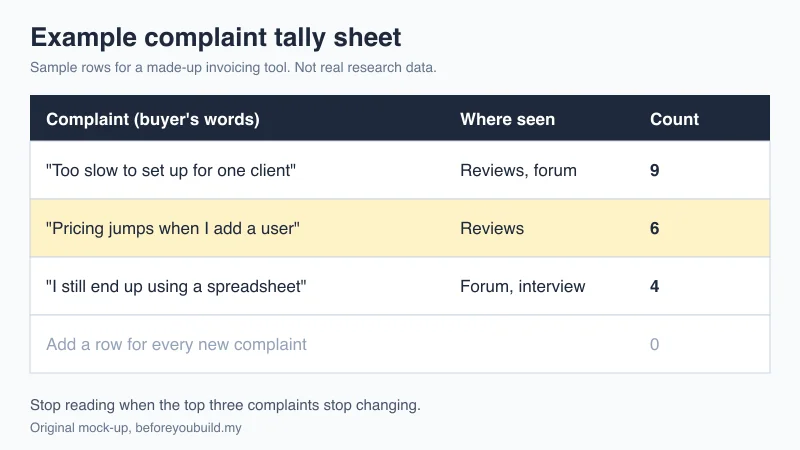
Keep a tally with three columns: the complaint, where you saw it, and a count. After about 30 items per source, themes repeat. When the top three stop changing, you have enough.
Two cautions apply. First, review sites and forums over-represent angry people. A loud complaint is not a large market. Second, copy phrases, not conclusions. You are collecting how buyers talk, which later becomes your landing page copy.
How Do You Run Customer Interviews with No Budget?
Run about eight to ten interviews of 15 to 20 minutes with people who match your target buyer, and ask about the last time the problem happened. Rob Fitzpatrick’s The Mom Test is built on this rule. The eight to ten range is a BeforeYouBuild working guideline.
Interviews are the one method that costs time you cannot get back, so aim them. The research goal here is to map the market: how people handle the problem now, what it costs them and which words they use. You are not testing your idea yet.
Fitzpatrick’s Mom Test promises to teach you how to learn if a business is a good idea “when everyone is lying to you.” Nobody lies on purpose. They are kind, and kindness is poor data.
So ask about the past, not the future.
- “Tell me about the last time you dealt with this.”
- “What did you try first? What happened?”
- “What does it cost you in time or money today?”
- “Who else is involved in the decision?”
Avoid “Would you use this?” and “Would you pay for it?” Both invite a polite yes. Our Mom Test question bank has more, and the customer discovery guide explains when to stop.
Finding people is the hard part. Use the communities from the last section. Message people who posted about the problem, say you are researching, and offer to share what you learn. Do not pitch.
If a short survey helps, keep it to five or six questions and build it in a free tool. See our list of free Google Forms alternatives for options. Treat survey answers as leads for interviews, not as proof.
When Does Market Research End and Validation Begin?
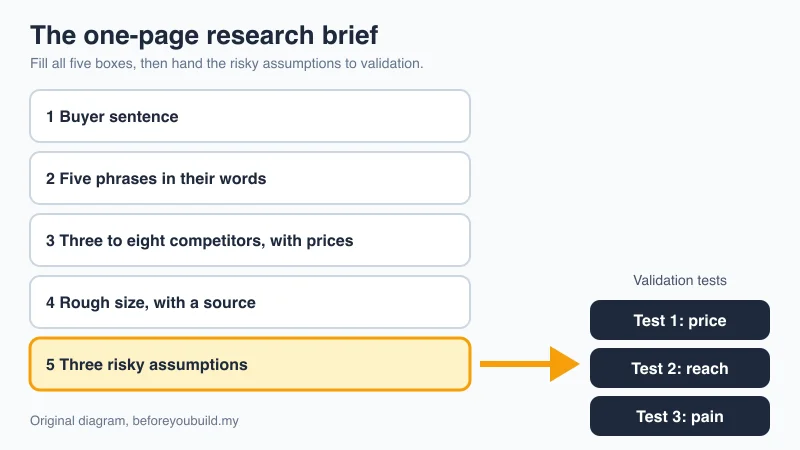
Research ends when you can fill a one-page brief and you have used your two-week cap. The brief holds a buyer sentence, five phrases in their words, three to eight competitors with prices, a rough size and three risky assumptions. Validation then tests those assumptions with real actions.
Open-ended research is how founders hide. More reading always feels safer than asking for a signup. So define “done” before you begin.
Fill this brief in one page:
- Buyer sentence: “[Specific person] who [situation] struggles to [outcome] and currently handles it by [workaround].”
- Five phrases: exact words buyers used in reviews, threads and interviews.
- Competitors: three to eight, with price, promise and one gap each.
- Rough size: a range and the source for it.
- Three risky assumptions: the things that must be true for this to work.
Each assumption becomes one validation test. If you assume buyers will pay $30 a month, you run a price test. If you assume you can reach them in one community, you post there and count replies. Our one-week idea test gives you a seven-day format, and the market validation guide ranks which signals count.
If you cannot fill the brief in two weeks, that is a result. Maybe you cannot name the buyer. Maybe you cannot find ten of them. Both are red flags worth knowing before you build. Skipping evaluation is not bold. It is expensive.
What Mistakes Waste a Solo Founder’s Research Time?
The most common research mistakes are researching with no stop date, treating search interest as demand and mistaking a big market for a reachable one. The CB Insights finding that 43% of 431 shutdowns cited poor product-market fit shows why fit matters more than size.
No stop date. Research expands to fill the time. Set the cap first.
Treating interest as demand. A rising trend line is not a buyer. It tells you people are curious, not that anyone will pay. That is what validation is for.
Starting with the idea, not the buyer. If you search for proof your idea is good, you will find it. Search for how people handle the problem and let the idea change.
Quoting big numbers. A report that says a market is worth billions says nothing about the few hundred buyers you can reach. Work from your reachable group.
Skipping your own notes. Memory keeps the exciting thread and drops the dull ones. Log everything, including the interviews that went nowhere.
Treating one source as the truth. Reviews skew angry, Trends skews broad and interviews skew polite. Each source is biased in a different direction, so use all of them and look for where they agree.
For a wider view of the process, see how to validate a business idea and our roundup of idea validation tools.
Frequently Asked Questions
How do I do market research for a startup with no money?
Use free sources: Census Business Builder for market data, Google Trends for search wording, competitor pricing pages, low-star reviews and community threads. Add eight to ten interviews. This takes roughly 18 to 27 hours of your time, a BeforeYouBuild working estimate, and almost no cash.
What is the difference between market research and market validation?
Market research maps the market: who the buyers are, what they pay and who competes. Market validation tests whether specific buyers will take a real step, such as joining a waitlist or paying a deposit. Research gives you a map, and validation tests the destination.
How long should startup market research take?
Two weeks is a sensible cap for a solo founder, at about two hours a day. That is a BeforeYouBuild guideline, not a published standard. A fixed stop date matters more than the exact length, because open-ended research tends to delay the first real test.
How many customer interviews do I need?
About eight to ten interviews with people who match your target buyer is a practical start for solo research. This is a working guideline, not a research result. Stop when answers repeat, and log every conversation so one enthusiastic call does not outweigh several lukewarm ones.
Is Google Trends enough for market research?
No. Google says Trends is not a scientific poll, and it scales data from 0 to 100, so low-volume terms can show as 0. Use it to compare wording and direction, then confirm with reviews, communities and interviews before you decide anything.
Ready to turn your research into a decision?
Fill in the one-page brief, pick your riskiest assumption and score the idea before you spend anything on building.
Run the Idea Validation Scorecard
15 minutes. Free. No pitch.
Keep Reading
What to Do Next
Choose the path that fits where you are right now.
Get the 7-Day Idea Test (Free)
Download the free 7-Day Idea Test. One task per day. Four evidence signals. One clear go, wait, or kill result — before you spend months building the wrong thing.
Send Me the PlaybookStart Reading
Read the step-by-step setup guide for your platform.