In this article
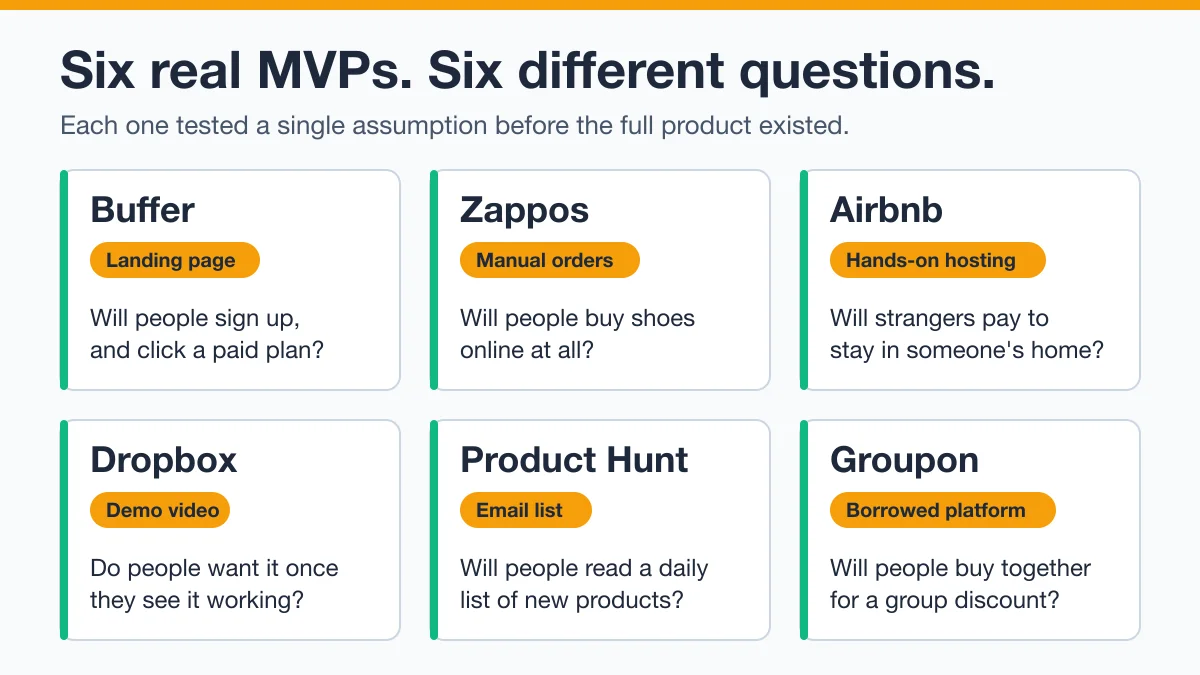
Buffer’s first MVP had no product behind it. It was a pitch page, a pricing page, and an email box. Zappos’ first test was a set of photos taken inside other people’s shoe stores.
Neither founder built the product first. Each built the smallest thing that could kill one assumption. This article walks through six real examples, what each one tested, and how a solo founder can borrow the method without borrowing the company.
An MVP is not a small product. Eric Ries, whose Lean Startup work made the term popular, defined it as “that version of a new product which allows a team to collect the maximum amount of validated learning about customers with the least effort.” The last phrase does the work. An MVP is a learning tool. The product is optional.
That is why the famous examples look odd next to the companies they became. Airbnb’s founders did not start with a platform. According to Wikipedia’s account of the company’s history, two roommates put an air mattress in their San Francisco living room in October 2007 and turned it into a bed and breakfast during a design conference.
Every example below follows the same pattern. The founder picked the assumption most likely to sink the idea, then built the cheapest thing that could test it. Some used a web page. Some did the work by hand. One used a video, and one started as an email list.
Two warnings before you read on. First, these are the companies that worked. You never see the thousands of MVPs that got no response, so treat each tactic as an option, not as proof. Second, copy the question each test answered, not the format. A clean test of the wrong assumption is still a wasted month.
If you want the step-by-step method, MVP for Solopreneurs covers it. This article is the evidence: what real founders actually did.
What Did Buffer Learn From Three Web Pages and No Product?
Buffer learned that people wanted the idea, and that some would click a paid plan, before Joel Gascoigne wrote a working version. He described the process in his own post on the Buffer blog.
His idea was narrow. Many Twitter apps had a scheduling feature. He wanted to make that one feature excellent, so you could queue tweets without scheduling each one. By his own account, he started coding before he had tested whether the business made sense, then stopped and decided to “do it the right way this time.”
The first test was two pages: a pitch and a place to leave an email. He tweeted the link, asked what people thought, and treated the emails and feedback that came back as his first validated learning. Then he added a pricing page between the two. That one extra click was the smart part. It showed which plan people chose, and it tested demand a second time, because only people who wanted the product would bother to click through. In his words, people “were still clicking through and giving me their email and a small number of people were clicking on paid plans.” Only then did he start building.
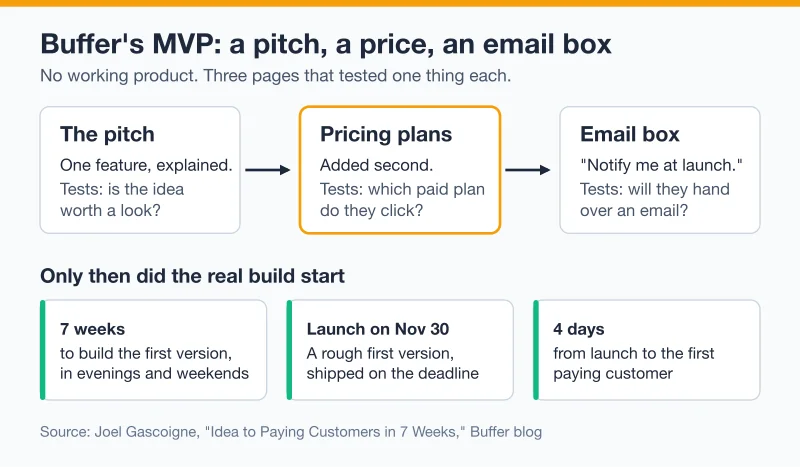
The build took seven weeks in evenings and weekends. Buffer went live on November 30, and Gascoigne reports his first paying customer within four days. About two and a half months after launch he counted over 500 users, with around 4% of people upgrading to a paid plan.
What to notice. The early evidence was soft. A few emails and some replies from people he already reached on Twitter is a friendly signal, the kind the $20/month product case study shows failing. What made Buffer’s test worth trusting was the price step. It asked people to choose a plan, which costs more than a like. Gascoigne also says his previous product suffered because he had not asked enough people whether it was a problem for them.
Your version. One page with the pitch, a pricing step, and an email box. Build it with any of the landing page builders compared here, send it to people who match your buyer, and use the one-weekend demand test to read the result.
When Should You Do the Work by Hand? Zappos and Airbnb
Do the work by hand when your biggest unknown is whether customers will buy at all, not whether you can build the software. Zappos and Airbnb both started this way.
Zappos. Nick Swinmurn wanted to know whether people were ready to buy shoes online. As Ries tells it, in the version summarized in Wikipedia’s Lean startup entry, Swinmurn did not build a footwear database or a warehouse. He approached local shoe stores, photographed their inventory, and posted the photos online. When someone ordered, he bought the pair from the store at full price and shipped it straight to the customer.
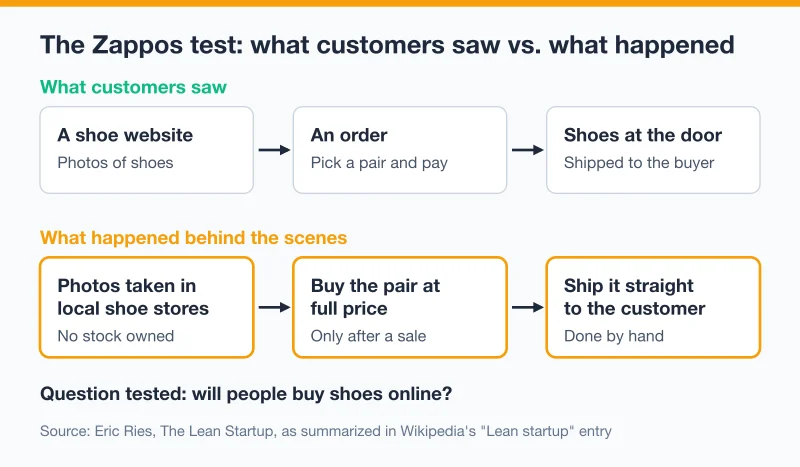
Nobody would call that a business model. It was an experiment with a shop window, and it answered one question: would people pay for shoes they could not try on? Then the model changed. Wikipedia’s Zappos entry notes that the company later moved away from holding no inventory, and quotes Tony Hsieh: “we couldn’t distinguish ourselves in the eyes of our customers if we weren’t going to control the entire experience.” The MVP proved demand. It did not prove the final model, and it was never meant to.
Airbnb. The air mattress in 2007 was the first test. The next one was even less scalable. Paul Graham, in “Do Things That Don’t Scale,” writes that Airbnb’s founders went door to door in New York, recruiting new users and helping existing ones improve their listings. He adds that about 30 days of that in-person work made the difference between success and failure early on. Nothing about it scaled, and Graham’s point is that it did not need to.
Your version. If your idea is a service, a coaching program, or a marketplace, the hand-built version is your MVP. Do the job manually for a few real customers before you write any code. The concierge form in MVP for Solopreneurs works this way: you do by hand what the product would eventually do, and the customer pays for the outcome.
Can a Video or an Email List Be Your MVP? Dropbox and Product Hunt
Yes, when your biggest unknown is whether people care, not whether you can build it. Dropbox used a video. Product Hunt used an email list.
Dropbox. According to Wikipedia’s Dropbox entry, Drew Houston conceived the idea after repeatedly forgetting his USB flash drive as a student at MIT. He founded the company in May 2007, secured seed funding from Y Combinator, and launched publicly at TechCrunch Disrupt in 2008. In a 2011 TechCrunch “Founder Stories” interview, as summarized there, Houston said a demo video went out in Dropbox’s early days. One viewer, Arash Ferdowsi, was so impressed that the two formed a partnership.
A file-sync tool is hard to describe and easy to show, so a demo does a job a paragraph of landing page copy cannot. You will see waiting-list numbers attached to this video in many retellings. This article leaves them out because they are secondhand. What the public record does support is the useful point: the video found people who cared, including a co-founder.
Product Hunt. Ryan Hoover launched Product Hunt on November 6, 2013 as an email list built with a tool called Linkydink. The first version of the website came later, built by Hoover and Nathan Bashaw over that year’s Thanksgiving break, per Wikipedia. The list was the product. If people opened a daily list of new products, there was something to build around.
Your version. For a tool that is hard to explain, record a short screen demo of the workflow and see who asks for access. If it is a mockup, label it as a preview. For a directory, newsletter, or community idea, send the list first and count who opens it, replies, and forwards it.
What If Your MVP Is Hiding Inside Something You Already Built? Groupon
Then your job is to watch what people do with it. Groupon began as a side effect of an earlier product.
Per Wikipedia’s Groupon entry, Andrew Mason launched The Point in 2007, a platform that used the “tipping point” idea to get people together around a cause. It gained only modest traction in Chicago until a group of users decided their cause would be saving money by buying the same product at a group discount. Groupon launched in November 2008 on the same platform. Its first deal was two pizzas for the price of one at Motel Bar, a restaurant on the first floor of the company’s own building. Each deal worked as an assurance contract: if enough people signed up, everyone got the deal, and if not, nobody did.
That is a small, local, low-risk test. One restaurant, one offer, one building. The demand signal did not come from a survey. It came from what users chose to do with a product that already existed.
Your version. You do not need to build a platform to run a first offer. Use what already exists: a payment link, a newsletter, a form, a community you already belong to. Then watch what people do, not what they say. The guide to validation signals before launch lists which behaviors count.
How Do You Choose an MVP When You Are Not Buffer?
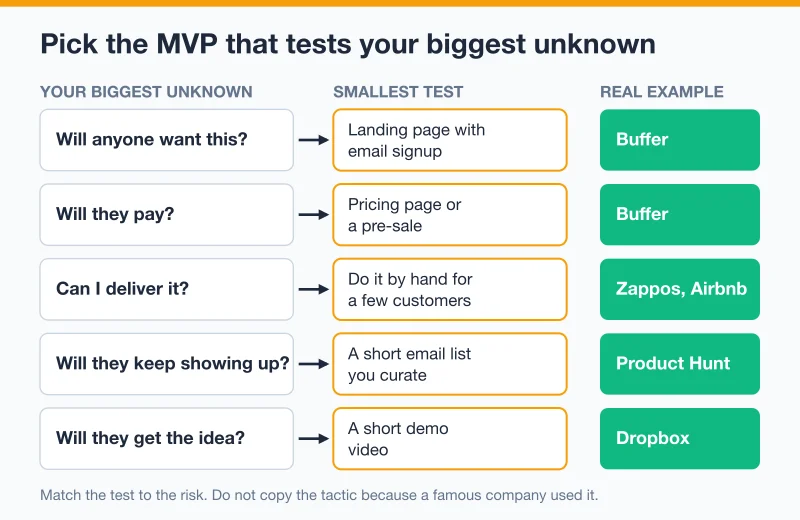
Start from the risk, not from the format. Ask which single assumption would kill your idea if it were wrong, then pick the cheapest test for that assumption.
Then set a pass mark before you run the test. Write down what result makes you build and what result makes you stop. A test with no pass mark turns into a story you tell yourself afterward.
A four-step version for a solo founder:
- Write your riskiest assumption in one sentence.
- Pick the smallest test from the chart that addresses it.
- Write the pass mark: what you will count, and how much of it is enough to continue.
- Run it for a fixed window, typically one to two weeks, and decide.
Keep three limits in mind, because these six examples do not prove as much as they seem to.
- They are survivors. The tests that returned silence do not get written up. The patterns behind failed product launches show what those look like.
- A passed test is not a business. Zappos changed its model after its test. Wikipedia also records that Groupon reported a 2011 fourth-quarter loss and restated its 2011 revenue downward in March 2012.
- Soft signals mislead. Buffer’s first check was a few emails and replies. The price click and the first paying customer carried the weight. The Mom Test explains why friendly feedback overstates demand.
To decide how much evidence is enough before you commit to building, read how much validation is enough.
Frequently Asked Questions
What is a good example of an MVP for a solo founder?
Buffer’s is the easiest to copy. Per its founder, it was a pitch page, a pricing page, and an email box, built before any working product existed. If your idea is a service rather than software, the Zappos approach fits better: do the job by hand for a few paying customers and learn what delivery really involves.
Is a landing page an MVP?
It can be. A landing page is an MVP when it is built to test one assumption, such as whether people will sign up or click a price. A page with no pass mark and no plan for getting visitors is only a poster. Buffer’s pricing step is what turned its page into a test.
What is the difference between an MVP and a prototype?
A prototype checks whether something can be built or used. An MVP checks whether anyone wants it. Some MVPs, like the Zappos photos or the Airbnb air mattress, contain no software at all. If your test needs weeks of building, you are probably making a prototype.
What if nobody responds to my MVP?
Treat it as a result. First check that the right people saw it, that the ask was clear, and that the price was visible. If all three hold, silence means this version of the idea is not worth building. The should I build this framework helps you decide whether to adjust the idea or drop it.
Keep Reading
- MVP for Solopreneurs: The Minimum You Need to Test Demand
- How Much Validation Is Enough Before You Start Building?
- How to Run a Demand Test in One Weekend
Not sure which assumption to test first? Run your idea through the evaluation framework. No sign-up required.
What to Do Next
Choose the path that fits where you are right now.
Get the 7-Day Idea Test (Free)
Download the free 7-Day Idea Test. One task per day. Four evidence signals. One clear go, wait, or kill result — before you spend months building the wrong thing.
Send Me the PlaybookStart Reading
Read the step-by-step setup guide for your platform.