In this article
You have expertise. You have a few clients who love working with you.
You are starting to think: what if I turned this into a course?
Stop before you open a curriculum template. Having expertise is not the same as having a market for a packaged, scalable version of it.
This framework gives you a structured way to check, before you spend two months building modules nobody buys.
Most course launches do not fail because the teaching is bad. They fail because the founder confused three different things: people who like their free content, people who would pay for one-on-one help, and people who would pay for a self-paced course. Those are three different buyer populations, and a course only works if the third one is large enough and specific enough to reach.
This framework has five demand signals to check, a format-fit test to choose between a course, a group program, and a membership, a pre-sell method you can run before writing a single lesson, and a go, wait, or kill decision model. None of it requires you to record a single video first.
What it does not do: guarantee your course sells. No framework does. What it gives you is a way to find out cheaply, before you invest in production tools and a launch calendar.
The Real Question Behind “Should I Create a Course?”
The question you are actually asking is not “can I teach this?” It is “will someone who does not already know me pay for the structured version of what I currently give away or deliver one-on-one?”
That distinction matters because your existing clients are not proof of course demand. They already trust you enough to pay for direct access. A course asks a stranger, or a follower who has only ever consumed your free content, to pay for a lower-touch version of the same outcome. That is a harder sell, not an easier one.
The same trap catches audience-driven creators. Having people who watch your content, read your newsletter, or comment on your posts tells you they like what you make. It does not tell you they will pay for a packaged product. Our post-mortem on a creator’s course launch covers exactly this gap between audience size and buyer count in detail.
Before you build, separate the two questions cleanly: is the problem real and painful enough that people pay to solve it, and is your specific packaging (a course, versus a program, versus a membership) the right format for how they want to solve it. The next two sections evaluate each separately.
Five Demand Signals That Say Your Course Idea Is Real
Check each of these before you write a single lesson outline. They require research, not guessing.
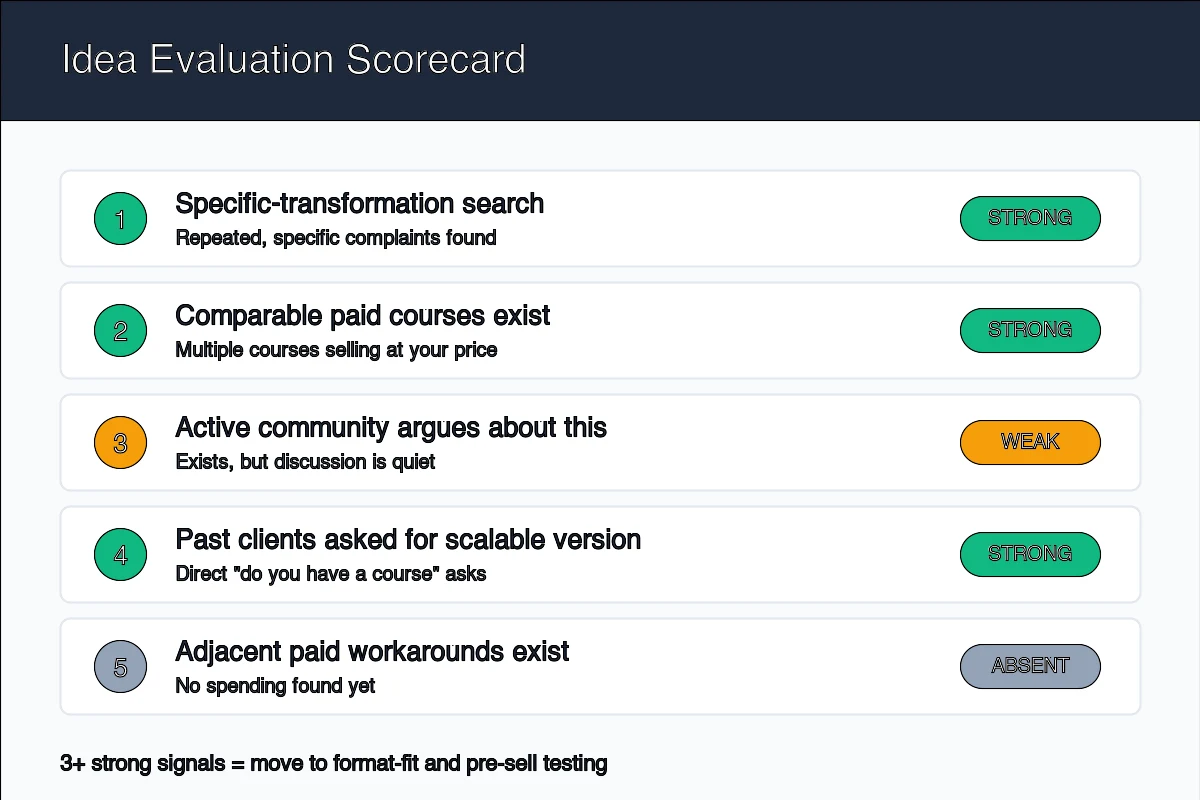
Signal 1: People search for the specific transformation, not the general topic
“How to get better at public speaking” is a topic. “How to stop rambling in client calls” is a transformation someone is actively trying to solve. Search the exact outcome your course promises, in the words your buyer would use, not the words you use as the expert. Look for forums, YouTube comments, and Reddit threads where people describe the specific struggle. General interest in a topic is weak evidence. A specific, repeated complaint about a specific outcome is strong evidence.
Signal 2: Comparable paid courses already exist at your target price
Search for existing courses addressing this transformation. If people are paying for imperfect versions already, that confirms willingness to pay at that price range. If you find genuinely nothing for sale anywhere in your space, that is usually not white space. It is more often a sign the market will not pay for a course on this, even if it will pay for coaching or done-for-you work.
Signal 3: An active community argues about this problem
Facebook groups, Discord servers, subreddits, and forums built around your buyer’s world are evidence the problem is real and recurring. A community with daily posts and real back-and-forth is a stronger signal than one with a handful of quiet posts a month.
Signal 4: Past clients have explicitly asked for a scalable version
If people who already pay you for one-on-one work have said something like “do you have a course for this?” or “can I just get the framework without the calls?”, that is one of the strongest signals available. It means someone with money already in hand asked for the lower-touch product. Absence of this request is not disqualifying, but its presence is a real green light.
Signal 5: People are already paying for a worse, adjacent solution
Generic templates, unrelated courses they are trying to adapt, or a string of one-off coaching sessions used as a workaround all count. When people cobble together an inferior substitute, they have already proven the problem is worth paying to solve.
Reading Your Signal Score
| Signal | Strong | Weak | Absent |
|---|---|---|---|
| Specific-transformation search | Repeated, specific complaints found | A few vague mentions | Nothing specific found |
| Comparable paid courses exist | Multiple courses selling at your price | One course, unclear traction | No paid courses found |
| Active community | Daily, detailed discussion | Exists but quiet | No community found |
| Past client requests | Direct “do you have a course” asks | Vague interest only | Never asked |
| Adjacent paid workarounds | Clear pattern of substitute spending | One or two mentions | No spending found |
Three or more strong signals means the idea has enough market evidence to move to the format-fit and pre-sell steps below. Fewer than three, or mostly weak signals, means you need more research before committing time to curriculum design.
Course, Group Program, or Membership: How to Pick the Format First
Assuming the demand signals hold up, the next decision is format. Coaches with several product options in mind (course, group program, membership) tend to pick based on which one they feel most excited to build, not which one fits how the buyer wants the outcome delivered. That is backwards.
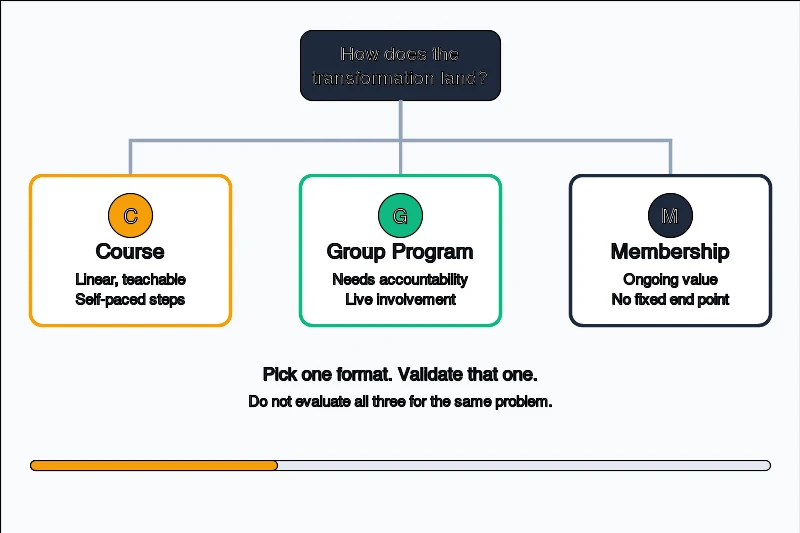
A course fits when the transformation is linear and teachable in defined steps. The buyer wants to move from A to B on their own schedule, and the path between them does not change much from person to person. Self-paced works because the content, not your live presence, is what delivers the result.
A group program fits when the buyer needs accountability and your direct involvement. If the transformation stalls without live feedback, deadlines, or a cohort pushing them forward, a self-paced course will show weak completion and weak results, even if the content is excellent. Group programs command higher prices because they sell access to you, not just information.
A membership fits when the value is ongoing, not a single transformation. If your buyer’s need keeps evolving (new content, new problems, a community that stays relevant month to month) a one-time course undersells what you actually offer, and a membership captures recurring value better.
Do not evaluate all three formats for the same problem. Pick the format that matches how the specific transformation actually gets delivered, then validate that one format with the pre-sell test below. Building a course for a problem that needs live accountability, or a membership for a one-time transformation, produces poor completion and refund requests regardless of how good the content is.
Have you actually validated demand for any digital product before, or are you about to guess for the first time? Run your idea through the Idea Validation Scorecard first. Ten questions, a clear go, wait, or kill score, free.
The Pre-Sell Test: Validate the Course Before You Build It
Once you know the format, test it before you build it. The pre-sell test answers the only question that matters: will people actually pay, not just say they are interested.
Step 1: Write the outcome, not the curriculum
Build a single page describing the specific transformation and a rough outline of how you get someone there. Skip video production entirely at this stage. The page needs to sell the outcome clearly enough that someone would hand over money for access on a stated future date.
Step 2: Set a real price and a real payment link
Use an actual checkout, not a “sign up to be notified” form. Interest without a payment step tells you almost nothing. Rob Fitzpatrick’s Mom Test framework exists specifically because people say they would buy things they never actually purchase. Our summary of the Mom Test covers how to read that gap when you talk to potential buyers directly.
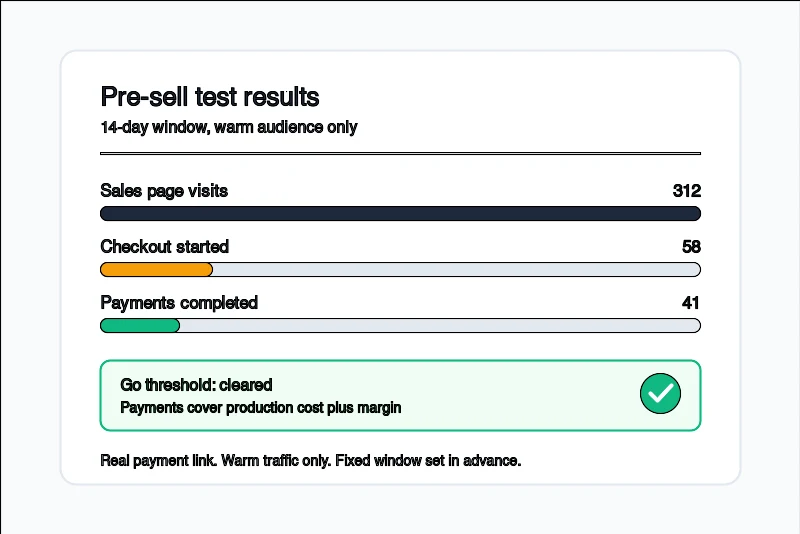
Step 3: Sell it to warm traffic only, for a fixed window
Email your list, post to your existing audience, and message past clients directly. Do not run paid ads at this stage. You are testing whether people who already know and somewhat trust you will pay, which is the easier bar. If that bar fails, cold traffic will fail harder. Run the window for a fixed period you decide in advance, commonly one to two weeks, so you are not tempted to keep the test open until you get the answer you want.
Step 4: Decide your go threshold before you launch, not after
Set your minimum acceptable result before the test starts. A common bar creators use is enough pre-sales to cover production costs plus a reasonable margin for the time invested. Deciding this in advance stops you from rationalizing a weak result once real (if disappointing) numbers are in front of you.
Audience-to-buyer conversion for new digital products from creators is frequently under 1 to 3 percent, according to post-mortems shared on Indie Hackers. If your list is small, that ratio matters more than the raw subscriber count. A pre-sell test targeted at a specific, painful transformation can still convert well even from a small list, because it is not selling to everyone, only to the people who have the exact problem.
If nobody pays during the test window, refund whoever expressed interest, and treat that as real information, not bad luck.
Three Course-Specific Traps That Kill Launches Before They Start
Trap 1: Mistaking audience size for buyer count
An audience that consumes your free content for free is not the same population as people who will pay for a course. Treat every follower, subscriber, or comment as a possible buyer only after the pre-sell test confirms it, never before.
Trap 2: Reading engagement as demand instead of reading payment as demand
Likes, webinar attendance, and “this is so helpful!” comments measure interest in your free content. They do not measure willingness to pay. Course creators consistently overestimate demand because free engagement feels like validation. Only a payment, even a small deposit, is a real signal.
Trap 3: Building the full curriculum before testing the offer at all
Once you have sunk two months into modules, slides, and a course platform, you are emotionally and financially invested in making the launch work, which makes it much harder to read a weak result honestly. The sunk cost problem shows up constantly in course launches specifically because production feels productive, while testing the offer feels like it is delaying the real work. It is not. Testing the offer is the real work.
Free, low-commitment courses illustrate the cost of skipping this step: platforms that track completion data, including Class Central, have repeatedly found completion for free online courses sitting in the single digits. Paid, pre-sold courses with a clear specific outcome see meaningfully better follow-through, largely because the buyer had to commit money before starting, which filters for people who actually have the problem.
The Go, Wait, or Kill Decision for Your Course Idea
After the five-signal check, the format-fit test, and the pre-sell test, you land on one of three verdicts.
Go. You found three or more strong demand signals, the format matches how the transformation actually gets delivered, and the pre-sell test cleared the threshold you set in advance with real payments, not just interest. Build the course. You still need to deliver it well, but you now know people will pay for it before you invest in production.
Wait. Signals are mixed. Maybe the demand is real but you tested the wrong format, or the pre-sell test came close to your threshold but did not clear it. Waiting means running one more test with a change (a different price, a narrower promise, a different format) rather than assuming the whole idea is dead. The value proposition canvas is useful here for documenting exactly which piece of the offer needs adjusting before you retest.
Kill. No specific-transformation search evidence, no comparable paid courses, no community discussion, and a pre-sell test that produced no payments from your warmest possible audience. Killing the course idea here costs you a few weeks. Discovering the same thing after building six modules and a launch sequence costs months, and a refund queue.
Frequently Asked Questions
Should I create an online course if I already have coaching clients?
Having paying coaching clients does not validate course demand on its own. Clients already trust you enough to pay for direct access, which is a different buying decision than paying for a self-paced product from someone they may not know at all. Run the pre-sell test on your actual list and audience, separate from your existing client base, before assuming the demand transfers.
How many email subscribers do I need before launching a course?
There is no fixed subscriber count that guarantees a course sells. A pre-sell test aimed at a specific, painful transformation can convert from a list under 500 if the offer is narrow and the problem is acute. A vague course pitched to a broad audience often underperforms even with a much larger list, because the offer is not specific enough to any one person’s problem.
What is the difference between a course and a membership for a coach?
A course delivers a defined transformation with a clear start and end point, built for self-paced learning. A membership delivers ongoing value (new content, community, evolving support) for a recurring fee, without a fixed finish line. Pick a course when the outcome is linear and teachable in steps; pick a membership when the value keeps changing and never fully resolves.
How long should I run a pre-sell test before deciding?
One to two weeks is a common window for a pre-sell test aimed at a warm audience. Set the exact length before you start, so you are not tempted to extend the test indefinitely while waiting for a better result.
What if my pre-sell test gets zero sales?
Zero sales from a real payment link, sent to your warmest audience, is a clear signal, not bad luck. Refund anyone who expressed soft interest, and treat the result as evidence that either the transformation is not painful enough, the price is wrong, or the format does not match how people want the outcome delivered. Retest with one specific change rather than abandoning validation altogether.
Keep Reading
What to Do Next
Choose the path that fits where you are right now.
Get the 7-Day Idea Test (Free)
Download the free 7-Day Idea Test. One task per day. Four evidence signals. One clear go, wait, or kill result — before you spend months building the wrong thing.
Send Me the PlaybookStart Reading
Read the step-by-step setup guide for your platform.