In this article
Your first product is you.
Not an app or a platform. You, doing the work by hand for a handful of real people, while you watch what they ask for, what they ignore and whether they pay. That is a concierge MVP, and it costs a few weeks instead of a few months.
What is a concierge MVP?
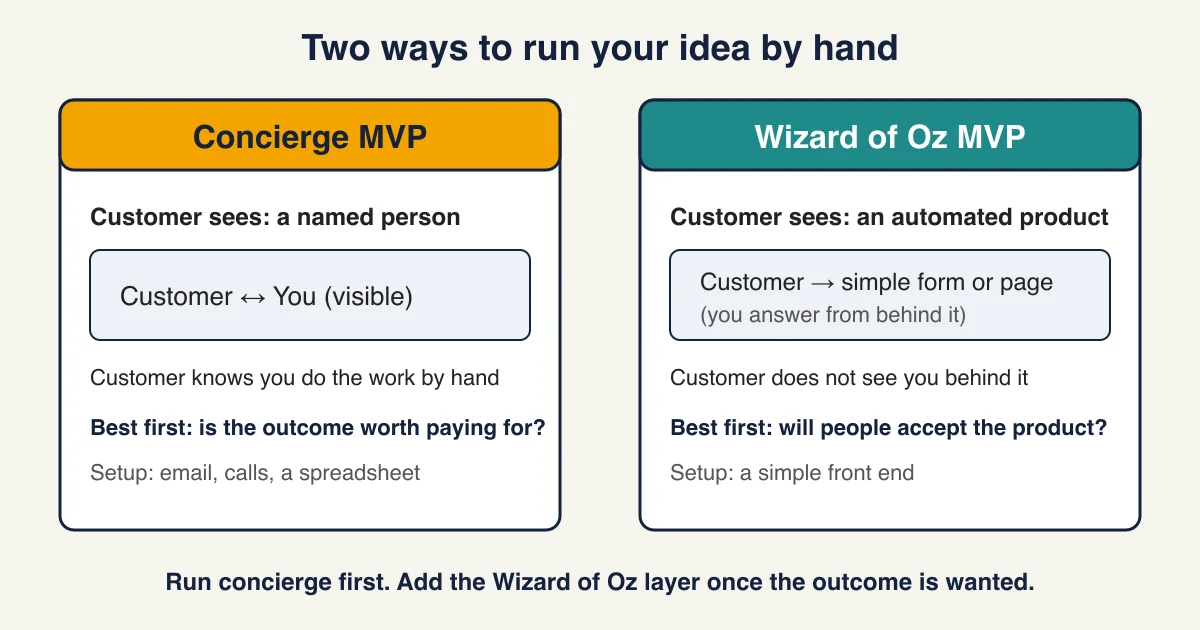
A concierge MVP is a minimum viable product in which you deliver the service to each customer personally, by hand, with no automation behind it. The customer gets the outcome they want. You get to learn what the work really involves, which steps matter and what people will pay for it.
The label is usually credited to Eric Ries’s book The Lean Startup (2011). The idea is older and simpler than the name: before you teach software to do a job, do the job yourself and see whether anyone cares.
Here is why that matters for a solo founder. Most ideas do not fail because the code was bad. They fail because the founder believed in a customer, a price or a process that was never checked. Building first hides that risk behind weeks of work. A concierge test puts the risk on the table in the first conversation.
The customer knows you are a person. That is the key difference from the Wizard of Oz variant we cover below, where the customer believes the system is automated.
Concierge testing is one of several cheap ways to test an idea. This table shows where it sits.
| Test | What the customer sees | What you do behind it | What it tests best |
|---|---|---|---|
| Concierge MVP | A personal service from a named human | Everything, by hand, openly | Whether the outcome is valuable and what the real process is |
| Wizard of Oz MVP | What looks like a working product | Everything, by hand, out of sight | Whether people use and pay for the product experience |
| Pre-sale page | An offer page with a pay button | Nothing yet, until orders arrive | Whether the promise and price get a “yes” |
| Built MVP | Working software | Weeks or months of building | Whether the product works at scale (only after the tests above) |
If you only need to know whether strangers will pay for a promise, the one-weekend demand test is faster. A concierge MVP is the next step up. It tests whether you can actually deliver the outcome, and whether people still want it once they have received it.
When does a concierge MVP beat other tests?
Use a concierge MVP when the value of your idea sits in the outcome, not the interface, and when you can serve a few people by hand. Skip it when the whole risk is a technical one that a person cannot fake.
It fits best when three things are true:
- The product is a service in disguise. Meal plans, audits, reports, matching, curation, onboarding, bookkeeping, research. If a person could do it with a spreadsheet and an inbox, you can test it by hand.
- You do not know the process yet. Founders often guess the steps wrong. Doing the work shows you which step is slow, which step the customer cares about and which step nobody notices.
- Your reachable market is small. If you can name a short list of people who might want this, you can serve a few of them personally.
It fits badly when the risk is technical (a real-time engine, a model that must learn from data) or when the product only works at volume, such as a marketplace that needs many buyers and sellers at once.
Paul Graham’s essay Do Things that Don’t Scale shows the same instinct at work. He writes that the Collison brothers, when someone agreed to try Stripe, would say “give me your laptop” and set them up on the spot. He says Airbnb’s founders went door to door in New York, helping hosts improve their listings, and that about 30 days of in-person engagement made the difference between success and failure. Those are manual-first moves from companies that later automated.
As the BeforeYouBuild assumption-mapping guide explains, every idea hides a belief that can kill it. A concierge MVP is one of the strongest ways to test that belief, because the customer receives something real and you see the reaction in full.
Does your idea feel like a service you could run from your inbox? Score it first with the Idea Validation Scorecard and see whether it is worth running by hand. Free. No pitch.
How do you run a concierge MVP step by step?
Pick one belief, one small group of customers and one clear pass line. Then deliver the service by hand, log every step and decide on the day you set in advance. A small solo test can fit in a few weeks of part-time work.
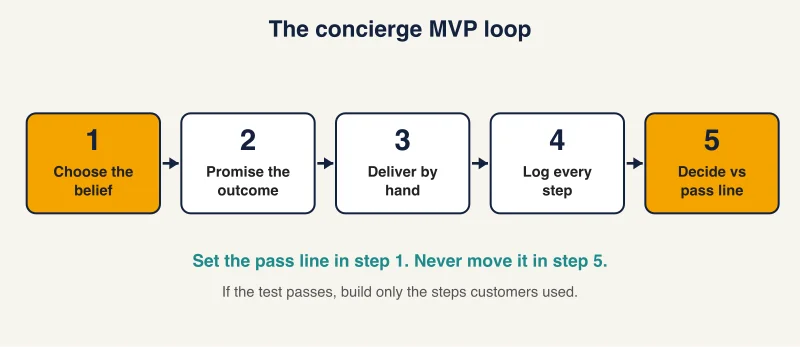
- Choose the belief you are testing. Write it as a sentence that can be wrong. “Freelance designers will pay $15 a month to have late invoices chased for them” can be tested. “People need better invoicing” cannot. If you are unsure which belief to pick, use assumption mapping first.
- Define the outcome you promise. Describe the result, not the process. “Your overdue invoices get chased every week and you get a short report on Friday.” That is what the customer buys.
- Find a handful of real customers. Use people who match your target customer and have the problem now. Not friends or family. Our Mom Test question bank helps you find them without leading the conversation.
- Charge something. Free work tests politeness. Payment tests value. Even a small paid pilot tells you more than a dozen enthusiastic replies. If you need to set the price, the willingness to pay survey guide shows how to avoid fooling yourself.
- Deliver by hand and log everything. Record what each customer asked for, how long every step took, what you improvised and what they said when they received the result.
- Decide on the date you set at the start. Compare the results with your pass line. Do not move the line afterward.
Write a test card before you contact anyone. Here is a worked example. It is an illustration, not a real result:
- We believe freelance designers will pay $15 a month for done-for-you invoice chasing.
- We will test it by offering the service by hand to 8 designers from two online communities, for 3 weeks.
- We will measure paid sign-ups, hours spent per customer per week and whether customers renew for week 4.
- We are right if at least 4 pay and I spend under 1 hour per customer per week. We are wrong if fewer than 2 pay.
The numbers are placeholders. Set yours from what the business needs to be worth your time. The format is the point: one belief, one number, decided in advance.
What is the Wizard of Oz variant and when should you use it?
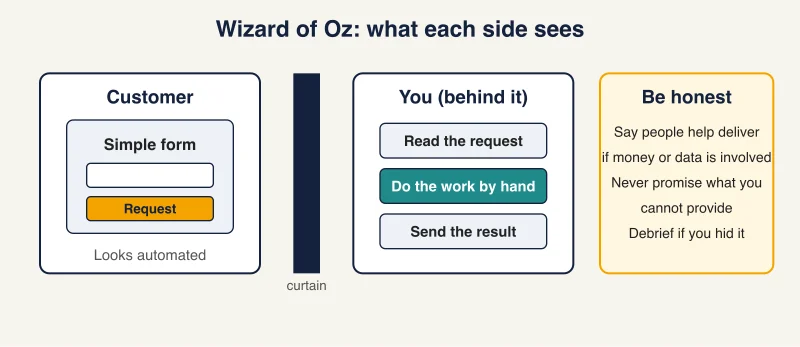
A Wizard of Oz MVP is a concierge test with one change: the customer believes they are using an automated product, while you operate it by hand behind the curtain. Use it when you need to learn how people behave with a product interface, not just whether they want the outcome.
In the field of human-computer interaction, a Wizard of Oz experiment is one where subjects interact with a computer system they believe is autonomous, but that is actually operated or partly operated by an unseen human. The same Wikipedia entry says John F. Kelley coined the phrase around 1980 during his doctoral work at Johns Hopkins University, after the hidden man behind the curtain in L. Frank Baum’s novel.
Nielsen Norman Group describes how UX teams use the method to test designs powered by complex technology at low cost. In its guide to the Wizard of Oz method, it says teams simulate the responses the technology might give by having a person play the system’s role. It also names the famous startup example: Zappos founder Nick Swinmurn tested demand by fulfilling orders himself. When orders came in through his website, he went to a local shoe store, bought the shoes and mailed them to the customer.
Here is how the two variants differ in practice:
| Concierge MVP | Wizard of Oz MVP | |
|---|---|---|
| Does the customer know a human is involved? | Yes | No, it looks automated |
| What you learn first | Whether the outcome is worth paying for, and what the work involves | Whether people use and accept the product experience |
| Setup effort | Almost none: email, calls, a spreadsheet | More: a simple front end such as a form, a page or a chat window |
| Main risk | Customers pay for you, not for the product | Pretending too much, or promising what you cannot yet deliver |
| Best first choice for a solo founder | Usually yes | After the concierge test passes |
Run the Wizard of Oz version only after the concierge test passes. Then you know the outcome is wanted, and the open question is whether people will accept it through a self-serve interface.
Nielsen Norman Group says the wizard is not usually revealed during a study to keep behavior realistic, and that deception studies need a debrief afterward. Take that seriously in a commercial test. If customers hand over money, personal data or time, be honest that people are involved in the delivery. You do not need to announce every manual step, but never claim an automation or an outcome you cannot provide.
What should you log and how do you read the results?
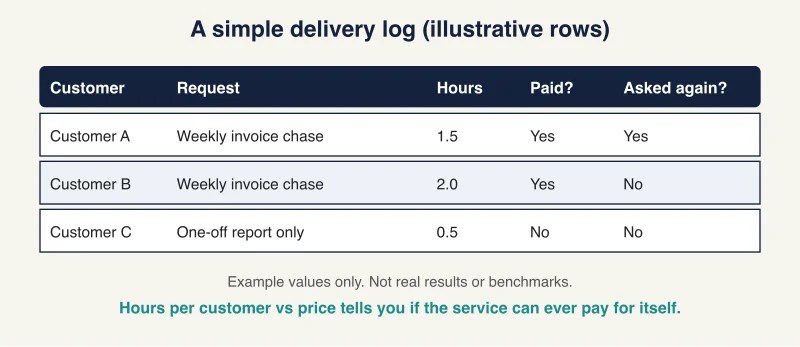
Log four things for every customer: what they asked for, how long each step took, whether they paid, and whether they asked for more. Then compare the pattern with the pass line you wrote before the test.
Keep a plain spreadsheet. One row per customer per delivery. The columns below do most of the work:
| What to log | Why it matters | What a bad sign looks like |
|---|---|---|
| Payment and renewal | Value you can bank, not praise | They like it but will not pay or come back |
| Hours per customer | The real cost of delivery | The service only works if you work for free |
| Steps they asked for again | The core of the product | Nobody asks for the step you planned to build first |
| Steps they ignored | What you can drop | They value the part you thought was a bonus |
| Where you improvised | The edge cases you will need to automate | Every customer needs a different fix |
| What they said unprompted | The words to use in your offer | They describe a different problem than the one you set out to solve |
Then read the result in three buckets:
- Pass. The customers paid, asked for more and cost fewer hours than they pay for. Write down the exact steps they used. That is your first product spec. Build only those.
- Fail. Few paid, or the work took far more time than the price covers. Change the customer, the promise or the price, and rerun a smaller test. Or kill the idea. A kill after a few weeks of manual work is cheap.
- Mixed. Some paid and some did not. Study the two groups. The difference usually shows you the real customer.
Do the hourly arithmetic honestly. Take what a customer pays per month and divide by the hours you spent on them. If the result is below what your time is worth, the product needs automation before it can work, and that automation is your first build. If it cannot get there even with automation, the idea is wrong at this price.
What are the traps and limits of a concierge MVP?
The main trap is mistaking your own effort for the product’s appeal. Customers may love working with you, and that tells you nothing about whether they would use a tool. The test shows demand for the outcome. It does not prove the software works.
Watch for four traps:
- Friendly customers. Friends and family are polite. Recruit people who match your target customer and who have a real, current problem.
- Free service. Without payment you learn whether people like free help. Charge from the first customer, even a small amount.
- Scope creep. Customers will ask for extras. Log each one, but deliver only the promised outcome. Otherwise you cannot tell which part drove the value.
- Never automating. A concierge MVP is a test, not a business model. If you pass, the next step is to build the smallest piece that removes your biggest manual step. As the MVP guide for solopreneurs says, build only what the test showed they used.
There are limits too. A manual test cannot show how the product behaves with thousands of users, whether the technology works at scale or how much it costs to run. It answers an earlier question: is this worth building at all? For real examples of what other MVPs tested, see examples of MVP.
Frequently Asked Questions
What is a concierge MVP in simple terms?
A concierge MVP is a minimum viable product where you deliver the service to each customer by hand, with no automation, and the customer knows a person is doing the work. It tests whether the outcome is valuable and what the process really involves. The term is usually credited to Eric Ries’s book The Lean Startup.
What is the difference between a concierge MVP and a Wizard of Oz MVP?
In a concierge MVP the customer knows a human delivers the service. In a Wizard of Oz MVP the customer believes the product is automated while you operate it by hand. Nielsen Norman Group describes the second method as a person playing the system’s role behind the scenes, usually without revealing them.
How many customers do you need for a concierge MVP?
A handful is enough, because the goal is to learn the process and test demand, not to produce statistics. Pick a number you can serve personally and set your pass line before you start, such as how many must pay. Treat any number as your own threshold, not an industry benchmark.
Is Zappos a concierge MVP or a Wizard of Oz MVP?
Zappos is most often cited as a Wizard of Oz example. Nielsen Norman Group says founder Nick Swinmurn tested demand by fulfilling orders himself: when orders arrived, he bought the shoes from a local store and mailed them. Customers saw a normal online store, not a person doing the work by hand.
Ready to test your idea by hand this week?
A concierge test works best with a clear belief to test and a decision date. The 7-Day Idea Test playbook gives you one task a day for a week, ending in a clear go, wait or kill decision.
Free PDF playbook. Enter your email and start today.
Keep Reading
What to Do Next
Choose the path that fits where you are right now.
Get the 7-Day Idea Test (Free)
Download the free 7-Day Idea Test. One task per day. Four evidence signals. One clear go, wait, or kill result — before you spend months building the wrong thing.
Send Me the PlaybookStart Reading
Read the step-by-step setup guide for your platform.