In this article
Every idea rests on beliefs you have not checked.
Some of them are harmless if they turn out wrong. One or two are not. If those fail, the whole idea fails with them, no matter how well you build.
Assumption mapping is how you find those one or two beliefs before you spend a month on code, slides or course videos. It takes about an hour, a pen and a blank page. The output is short: one belief to test this week, and the line that tells you whether the idea lives.
What is assumption mapping?
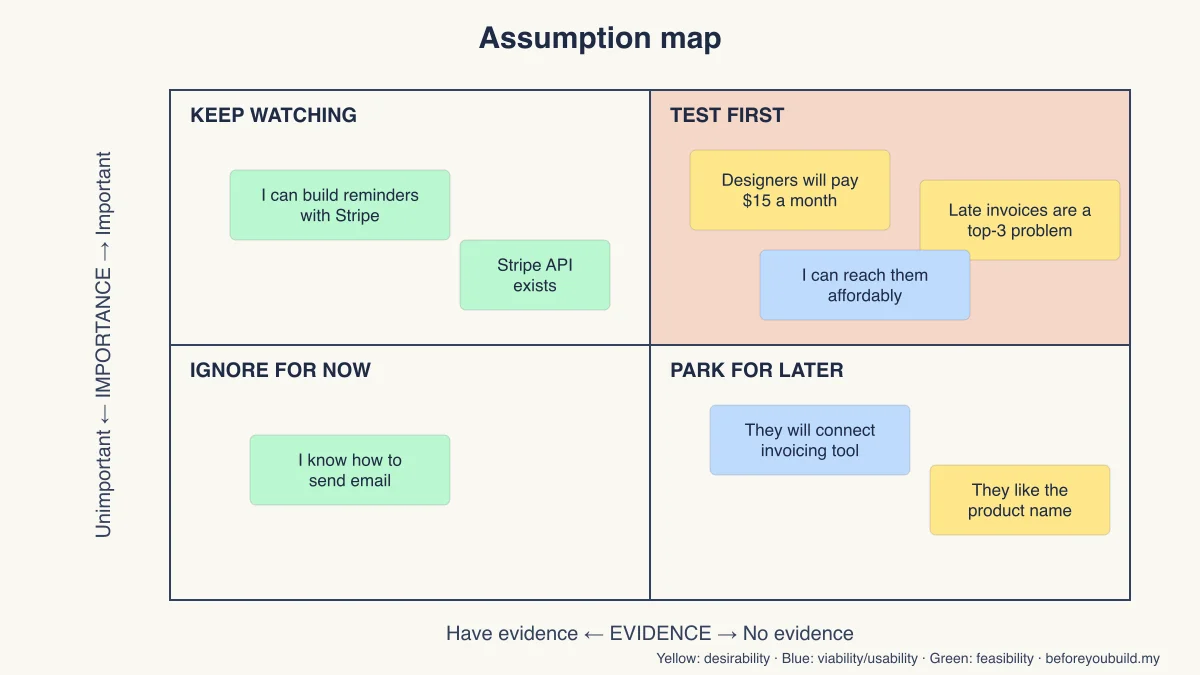
Assumption mapping is a prioritization exercise that sorts the beliefs behind an idea by two things: how important each belief is to the idea working, and how much evidence you already have that it is true. Beliefs that are critical and unproven go to the top of your testing list.
The method in its current form comes from David J. Bland, co-author with Alexander Osterwalder of Testing Business Ideas. On Precoil’s Assumptions Mapping page, Bland explains that he first learned the two-by-two grid from Jeff Gothelf, Josh Seiden and Giff Constable, the people behind Lean UX. Teams could draw the grid but still did not know which experiment to run. So he added the design-thinking themes of desirable, viable and feasible as colors, and spent years reworking the axis labels with teams until they settled.
Bland put the exercise under a Creative Commons license so anyone can use and adapt it. Precoil says it has been used for side projects, startups, small businesses, large companies and government agencies, and that it was pulled into Google’s Design Sprint Kit.
Teresa Torres, author of Continuous Discovery Habits, describes the same two factors in her assumption testing guide: how important the assumption is to the success of the idea, and how much evidence you already have for it. Her definition of the riskiest assumption is the one worth memorizing. It is a belief that is critical to success and has little evidence that it is safe.
Here is why this matters more for a solo founder than for a funded team. A team that tests the wrong thing loses a sprint. You lose your evenings for a quarter, and often your nerve to try the next idea. The map exists to stop you spending that time on the beliefs that were never going to sink you.
Most first-time founders do the opposite. They test what is easy and pleasant: whether friends like the name, whether the landing page looks good, whether they can build the thing. Those are real assumptions. They are rarely the ones that kill the idea. As we cover in the assumption trap, the belief that usually kills a solo product is “people want this enough to pay for it,” and it is the one founders check last.
Which assumptions does an idea actually depend on?
Start by writing every belief that must be true for the idea to work. Not what you hope. What must be true.
The useful trick is to sort them into types as you go. Each type catches a different blind spot, and a list with only one type in it means you have not looked hard enough.
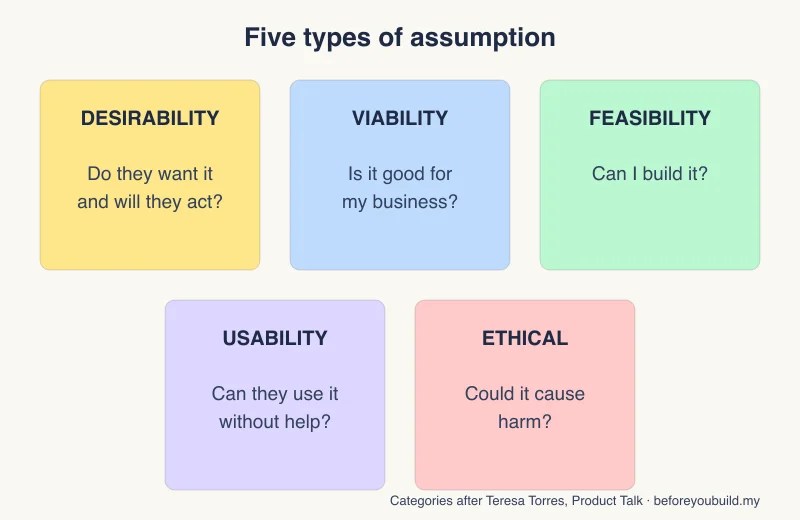
Torres groups product assumptions into five categories. Marty Cagan of Silicon Valley Product Group names four big risks in The Four Big Risks: value, usability, feasibility and business viability. The two lists overlap almost completely, so here they are side by side, with the question a solo founder should ask for each.
| Assumption type | Torres’s question | Cagan’s matching risk | What it sounds like for a solo idea |
|---|---|---|---|
| Desirability | Why do we think customers want this and will do what we need them to do? | Value risk | “Freelance designers lose hours chasing late invoices and want that fixed.” |
| Viability | Why do we think this will be good for our business? | Business viability risk | “Enough of them will pay $15 a month for me to replace my contract income.” |
| Feasibility | Why do we think we can build this? | Feasibility risk | “I can build the reminder logic with Stripe and a no-code tool in four weekends.” |
| Usability | Why do we think the customer can use it? | Usability risk | “They will connect their invoicing tool without help.” |
| Ethical | Is there potential harm in building it? | (folded into viability) | “Automated reminders will not damage my customers’ client relationships.” |
Sources: Teresa Torres, Product Talk; Marty Cagan, SVPG.
Cagan’s point is worth taking personally. He writes that viability risk is the one product people most often under-appreciate or avoid. His examples include whether you can acquire customers cost-effectively and whether you can monetize the product at all. Solo founders skip these for the same reason product managers do: they are uncomfortable questions with no code involved.
Two prompts help you get the list out of your head:
- Walk the customer’s path. Go step by step from “has the problem” to “pays you every month.” Every step hides an assumption: they notice the problem, they look for help, they find you, they trust you, they pay, they stay.
- Run a quick pre-mortem. Imagine it is a year from now and the idea failed. Write the three most likely reasons. Each reason is an assumption you were treating as true. Torres lists the pre-mortem as one of her favorite ways to catch final blind spots.
Write each assumption as a plain sentence that could be proven wrong. “People like the idea” cannot be tested. “At least 5 of 20 freelance designers I interview will describe late invoices as a top-three problem without my prompting” can be.
Aim for 15 to 30 sentences. Fewer than ten usually means you are only listing the comfortable ones.
How do you plot an assumption map?
Draw two lines on a page. That is the whole tool.
The vertical axis is importance: how badly the idea breaks if this belief is wrong. The horizontal axis is evidence: how much real proof you have that it is true. The convention on Bland’s grid puts “have evidence” on the left and “no evidence” on the right, so the danger zone sits top-right. You can flip it if that reads more naturally. Just keep it consistent.
Then place every sentence from your list on the grid, one at a time:
- Ask the importance question. “If this is false, is the idea dead, damaged or fine?” Dead goes near the top. Fine goes near the bottom.
- Ask the evidence question. “What have I seen with my own eyes that proves this?” Paid orders, signed pre-sales and unprompted complaints from strangers count as strong evidence. Your own experience, a friend’s enthusiasm and “everyone knows” count as none.
- Place it, and move on. Do not debate a single note for ten minutes. Rough placement is enough. The goal is the shape of the map, not precise coordinates.
Be strict on evidence. The most common mistake is giving yourself credit for opinions. If the only proof is that you would buy it, the note goes on the right side of the grid. We go deeper on why in confirmation bias and startup ideas.
When you finish, the four quadrants tell you what to do with each belief:
| Quadrant | Importance | Evidence | What to do |
|---|---|---|---|
| Top right | High | Little or none | Test first. These are your leap-of-faith assumptions. |
| Top left | High | Strong | Keep watching. Recheck if the market or your offer changes. |
| Bottom right | Low | Little or none | Park. Learn about these later, once the idea survives. |
| Bottom left | Low | Strong | Ignore for now. |
A healthy map for an untested idea has a crowded top-right corner. That is normal. It does not mean the idea is bad. It means you have not tested it yet, which is exactly why you are here.
How do you pick the one assumption to test first?
Pick the single note furthest into the top-right corner. If two are close, pick the one that, if wrong, makes the other one irrelevant.
For most solo ideas, that note is a desirability or viability belief. “This problem is painful enough that people already pay to solve it.” “They will pay my price.” Feasibility beliefs rarely win, because a solo founder can usually build a small version of most things. Whether anyone wants it is a different story.
This is where the map earns its keep. Without it, founders test the note closest to their comfort zone. A developer prototypes. A designer polishes the landing page. A coach writes the curriculum. All three feel productive and leave the idea’s fatal belief untouched.
CB Insights’ review of startup shutdowns shows how this plays out at scale. It studied 431 VC-backed companies that shut down since 2023 and could identify failure reasons for 385 of them. Running out of capital topped the list at 70%, but CB Insights calls that the final cause of death, not the root problem. The more telling causes were poor product-market fit at 43%, bad timing at 29% and unsustainable unit economics at 19%. Those are desirability and viability beliefs that were never proven.
Those companies had teams, funding and runway. A solo founder has far less room to learn the same lesson late, which is why the first test should go straight at the riskiest belief.
Not sure your idea is ready to test? The Idea Validation Scorecard scores your idea on 15 checkpoints in five categories and gives you a go, wait or kill read in about 20 minutes. Free. No pitch.
How do you turn the riskiest assumption into a test?
A belief becomes testable when you write down four things before you start: the belief, the test, the signal you will measure and the line that decides it. Writing the line first is what stops you moving the goalposts once results come in.
Strategyzer’s page for Testing Business Ideas describes its library of 43 experiment types, organized by cost, time and strength of evidence. You do not need all of them. A solo founder can cover most early beliefs with three or four cheap tests:
| Riskiest belief | Cheap test | Signal to measure | Example pass line |
|---|---|---|---|
| The problem is painful and frequent | Problem interviews using Mom Test questions | Unprompted mentions of the problem and what they already spend on it | 5 of 10 people describe it without prompting and name a current workaround |
| People will look for a fix | Search and community check | Questions, complaints and paid workarounds in places they already gather | Repeated, recent threads asking for a solution |
| They will pay my price | Pre-sale or deposit on a simple offer page | Paid orders, not email signups | A set number of paid pre-orders within a set time |
| I can reach them affordably | Small outreach or ad test | Replies or clicks per dollar or hour spent | A reply rate you can afford to repeat at scale |
The pass lines in that table are illustrations, not industry benchmarks. Set your own before the test, based on what the business needs to be worth your time. If you need 200 customers at $15 a month to replace your income, a test that gets 2 pre-orders from 400 visitors tells you something specific about that goal.
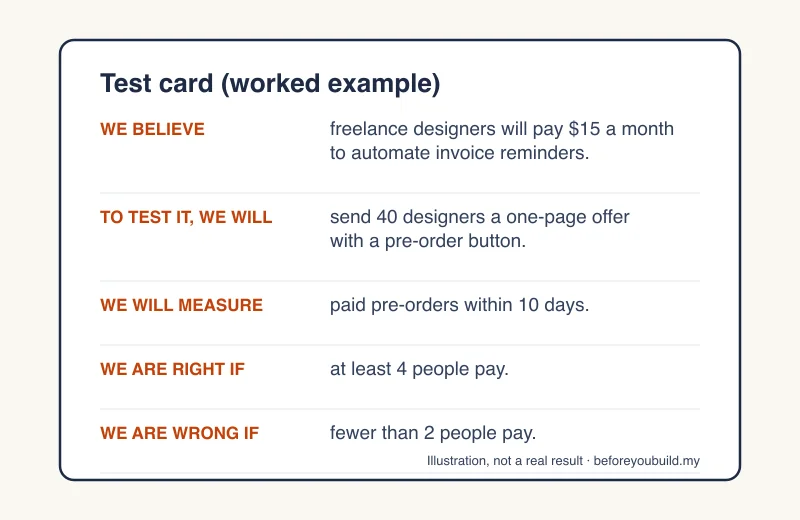
Write a short test card for the belief you picked:
- We believe freelance designers will pay $15 a month to automate invoice reminders.
- To test it, we will send 40 designers in two online communities a one-page offer with a pre-order button.
- We will measure paid pre-orders within 10 days.
- We are right if at least 4 people pay. We are wrong if fewer than 2 do.
That card is a worked example, not a real result. The format is the point: one belief, one test, one number, decided in advance.
For a fast way to run the pre-sale version, the one-weekend demand test walks through the offer page and the outreach step by step.
What do you do after the test?
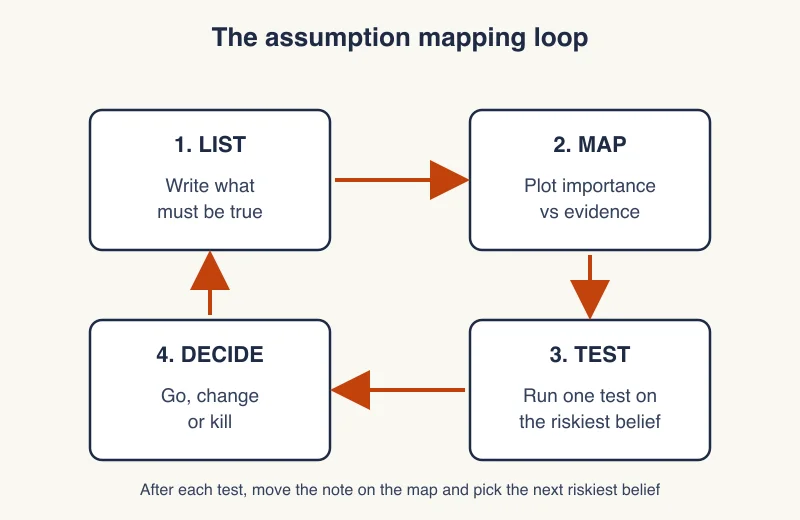
Move the note. That is the step most people skip.
If the test passed, the belief slides left on the map: you now have evidence. The next note in the top-right corner becomes your new first test. If the test failed, you have three honest options:
- Change the idea. Rewrite the belief for a different customer, price or problem, and put the new version back on the map.
- Change the test. Only if the test itself was flawed, such as reaching the wrong people. Be honest here. “The test was flawed” is the most common excuse for ignoring a clear result.
- Kill the idea. If the belief was critical and the evidence says no, stop. Killing an idea after a week of testing is a good outcome. Killing it after six months of building is the expensive one.
Repeat the loop until the top-right corner is empty or nearly so. For most solo ideas that is two to four tests over a few weeks, which fits inside the time frame of a structured idea validation framework.
Keep the map. Date each version. When you look back in three months, the record of what you believed, what you tested and what moved is the most useful document you will have about the business. It also keeps you honest when the idea starts to feel obvious and you are tempted to stop checking.
One caution before you start. An assumption map is not a scoring tool and it is not a business plan. It does not tell you whether an idea is good. It tells you what you need to find out, in what order, before you decide. Pair it with real conversations from customer discovery and a simple one-page model like the lean canvas for solopreneurs, and the map becomes your testing plan.
Frequently Asked Questions
What is assumption mapping in simple terms?
Assumption mapping is a one-page exercise where you list every belief your idea depends on, then plot each on a grid by importance and evidence. Beliefs that are critical and unproven get tested first. David J. Bland popularized the method, and Precoil shares it under a Creative Commons license so anyone can use it.
What are the two axes on an assumption map?
The two axes are importance and evidence. Importance asks how badly the idea breaks if a belief is wrong. Evidence asks how much real proof you already have that the belief is true. Teresa Torres of Product Talk names these same two factors as the way to find your riskiest assumptions.
How many assumptions should I put on the map?
Aim for 15 to 30 written assumptions for a solo idea. Fewer than 10 usually means you listed only the comfortable beliefs and skipped viability and desirability. Cover all five types Teresa Torres describes: desirability, viability, feasibility, usability and ethical, then test only the one or two that land in the top-right corner.
Is assumption mapping the same as a riskiest assumption test?
No. Assumption mapping is the step that finds your riskiest assumption. The riskiest assumption test is the experiment you run on it afterward, such as a pre-sale or a set of problem interviews. Strategyzer’s Testing Business Ideas catalogs 43 experiment types for that second step, sorted by cost, time and strength of evidence.
How long does assumption mapping take for one person?
Listing and plotting assumptions takes about an hour for one person working alone. Testing the riskiest belief takes longer, usually one to two weeks for a pre-sale or 10 problem interviews. Most solo ideas need two to four test rounds before the top-right corner of the map is clear enough to decide.
Ready to test your riskiest assumption this week?
The map tells you what to test. The 7-Day Idea Test playbook tells you how: one task a day for a week, ending in a clear go, wait or kill decision.
Free PDF playbook. Enter your email and start today.
Keep Reading
What to Do Next
Choose the path that fits where you are right now.
Get the 7-Day Idea Test (Free)
Download the free 7-Day Idea Test. One task per day. Four evidence signals. One clear go, wait, or kill result — before you spend months building the wrong thing.
Send Me the PlaybookStart Reading
Read the step-by-step setup guide for your platform.